
In 2026, “compliant hiring” with an Employer of Record (EOR) isn’t just getting someone onboarded quickly. It means your hiring process can withstand local labor law scrutiny across the full employee lifecycle: contract terms, statutory benefits, payroll/tax remittances, working time/leave rules, and lawful termination steps—plus the newer layer of AI governance when tools touch recruiting decisions.
An EOR partner like KuddleandCo is most valuable when it turns local compliance into a repeatable operating system—not a country-by-country scramble.
Key Benefits

Employment contracts that match local law and your business protections
A compliant hire starts with the right local employment agreement: correct role/terms, probation rules, notice language, and required clauses (where applicable). Many EOR guides emphasize that EORs handle locally compliant contracts and employment administration as core responsibilities.
What “good” looks like in 2026
- Country-specific templates (not one global template with minor edits)
- Change control for contract amendments (comp, title, location, work arrangement)
- Documentation that is audit-ready from Day 1

Statutory benefits + mandatory payments are handled as “non-negotiables”
Local compliance isn’t optional when it comes to statutory benefits and mandatory pay elements. An EOR’s job is to ensure payroll, contributions, and required payments are administered correctly in the employee’s jurisdiction.
Operational reality: this is where many companies “miss” compliance—because mistakes look small until they become penalties, disputes, or reputational issues.

Payroll is compliant only if remittances are correct and on time
A hire isn’t compliant if payroll is late, deductions are wrong, or statutory contributions aren’t remitted correctly. Modern EOR positioning consistently ties compliance to payroll + tax/statutory administration.
How top providers reduce risk
- Locked payroll calendars and approval cutoffs
- Exception workflows (retro pay, allowances, off-cycle pay)
- Clear responsibility matrix: who approves comp changes and when

“Work from anywhere” needs a location-control policy (tax + labor risk)
Remote-first hiring introduced a hidden compliance lever: where the employee is actually working. The OECD has explicitly updated guidance to address cross-border “home office” arrangements and how they can be treated under tax treaties—relevant to permanent establishment (PE) risk and cross-border exposure.
Compliant hiring in 2026 includes
- Location-change approvals (not just “FYI I moved”)
- Role-based risk flags (sales/leadership presence is typically higher risk)
- Documented rationale for cross-border work arrangements

Termination compliance is part of “compliant hiring” (because disputes start at exit)
A lot of “compliance debt” shows up at termination: notice, severance eligibility, documentation steps, and final pay timelines vary widely by jurisdiction. The ILO maintains country-by-country resources showing how severance and redundancy rules differ across jurisdictions—highlighting why global one-size exit policies fail.
What top EORs do
- Country-specific termination playbooks (just cause vs authorized cause equivalents, where relevant)
- Required documentation checklists and escalation gates

2026 adds a new compliance layer: AI-in-HR governance (especially in the EU)
If you use AI tools in recruiting, screening, or employee decisions in the EU, the EU AI Act timeline matters. The European Commission’s official timeline states the AI Act is fully applicable from 2 August 2026, with certain obligations applying earlier and some high-risk transitions extending later.
There has also been reporting about proposals to delay certain “high-risk” rules to December 2027, so companies operating in the EU should design governance that can handle timeline shifts without pausing controls.
What “compliant hiring” means here
- Maintain an AI tool register for HR use
- Document human oversight for decisions influenced by tools
- Keep auditable decision trails (especially for candidate screening/selection)
Conclusion
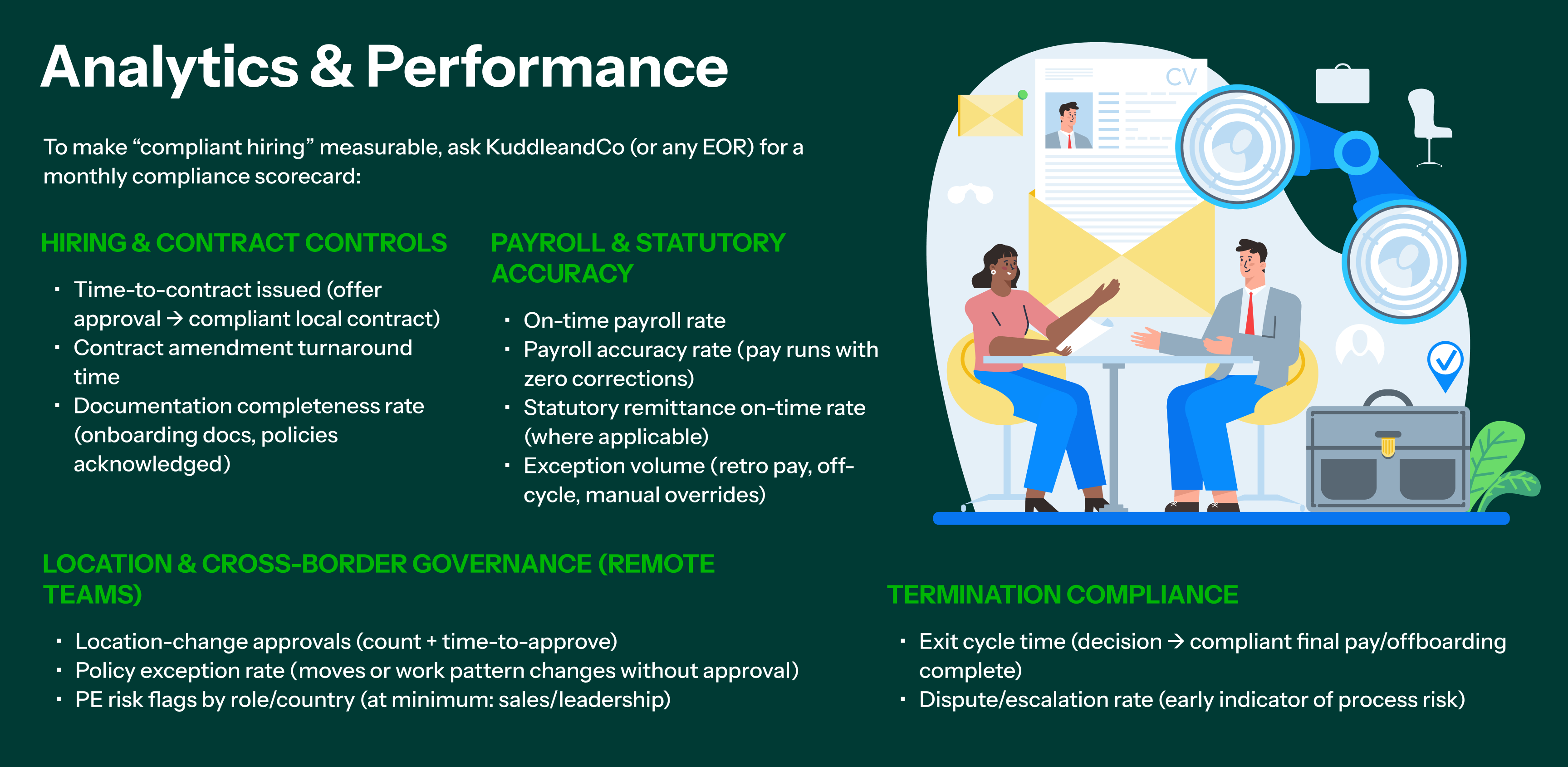
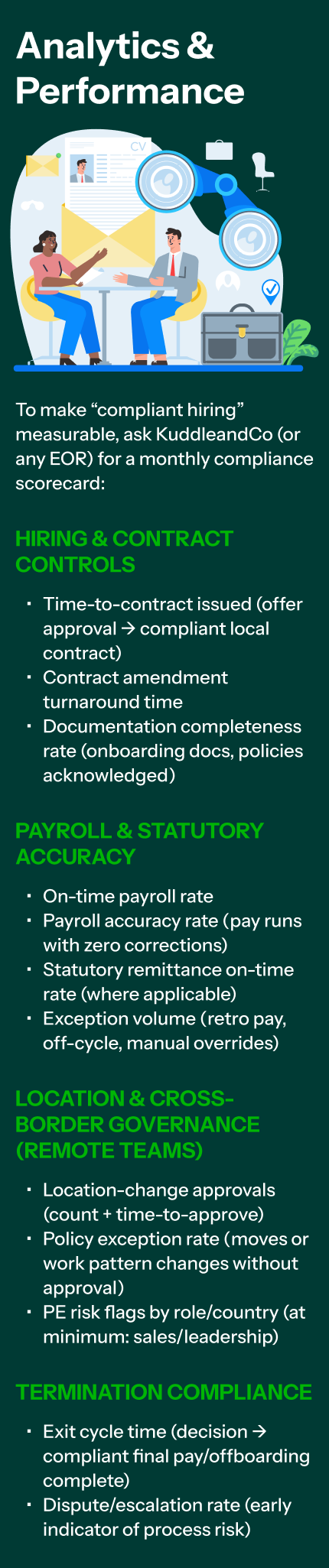
In 2026, “compliant hiring” with an EOR means lifecycle compliance, not just fast onboarding:
- locally correct contracts and documented processes
- accurate payroll + statutory compliance with strong controls
- location governance that reduces cross-border risk for remote teams
- termination playbooks that prevent disputes and inconsistent exits
- AI-in-HR governance readiness as 2026 EU timelines approach
Position KuddleandCo as the EOR partner that makes compliance operational: policy + payroll + protection, backed by reporting you can defend in audits and boardrooms.
References
- European Commission — AI Act timeline and applicability
- European Commission — Navigating the AI Act (FAQ)
- OECD — Press release on cross-border remote work guidance
- OECD — The 2025 Update to the OECD Model Tax Convention (PDF)
- KPMG — OECD guidance on permanent establishment and remote work