
Fast-growth companies in 2026 are scaling in two directions at once: headcount (more roles, faster) and geography (more states/countries, more complexity). That’s why the “PEO vs. EOR” decision isn’t just HR ops—it’s a risk + speed-to-market choice that affects payroll, benefits, compliance exposure, and how quickly you can hire where the talent is.
If you’re evaluating options with KuddleandCo as part of your vendor shortlist, the most reliable way to decide is to start with a simple question:
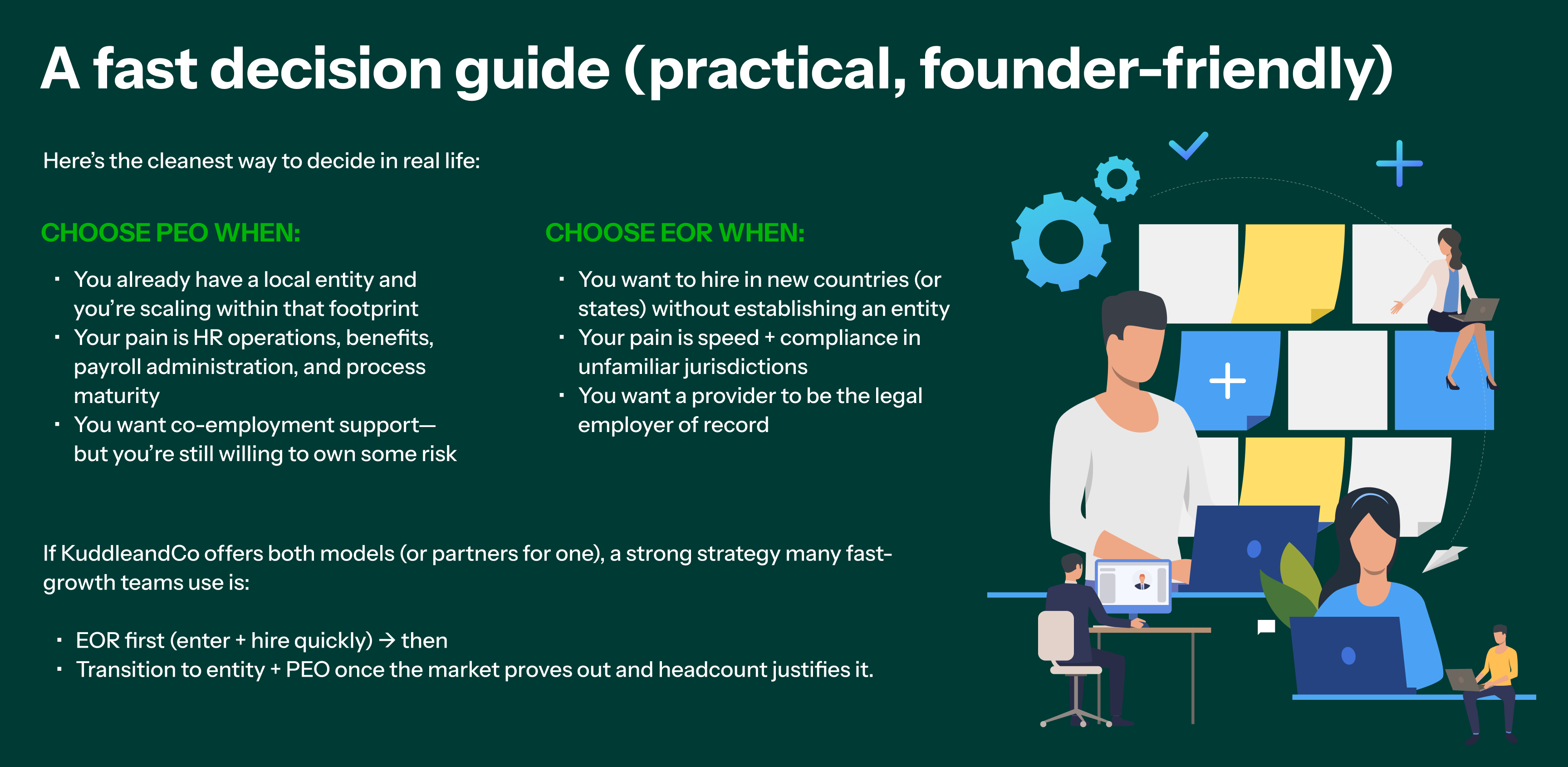
Do you already have (or want) your own legal employing entity where you’re hiring?
- Yes → you’re generally in PEO territory (co-employment support).
- No / Not yet → you’re generally in EOR territory (the provider becomes the legal employer).
(The exact structure can vary by country/state and provider model, so always validate the legal setup in your target jurisdictions.)
Key Benefits
What a PEO is best for (the “scale your HR engine” play)
A PEO (Professional Employer Organization) typically supports companies that already have a local entity and want to outsource key HR functions—payroll administration, benefits, HR compliance support, and HR operations—often through a co-employment arrangement.
Where PEOs shine in 2026
- Benefits leverage for retention: Competitive benefits packages can be easier to offer through a PEO’s aggregated buying power (varies widely by provider and region).
- HR process maturity fast: Policy templates, onboarding flows, handbook support, and standardized HR operations—useful when you’re hiring 10→100+ quickly.
- Multi-state HR simplification (where applicable): Centralizing payroll + HR administration can reduce operational drag as you expand across jurisdictions.
- Tax confidence (US lens): If you’re working with a CPEO (Certified PEO), the IRS certification framework adds clarity around certain federal employment tax responsibilities.
Typical “best fit”
- You’re scaling primarily within a country where you already operate.
- You want to keep your own entities and HR control, but upgrade HR infrastructure quickly.
- You have leadership bandwidth to still own parts of compliance/risk (because co-employment ≠ full transfer of responsibility).
What an EOR is best for (the “hire anywhere now” play)
An EOR (Employer of Record) is typically the legal employer on paper for workers in a target jurisdiction, enabling you to hire without setting up your own local entity. The EOR handles payroll, tax withholding, statutory benefits, and local employment compliance, while you manage day-to-day work and performance.
Where EORs shine in 2026
- Speed-to-hire in new countries/regions: Ideal for entering a new market, testing a region, or hiring scarce talent quickly.
- Compliance “coverage” across jurisdictions: Practical when you don’t want to build local legal + payroll expertise in-house for each new location.
- Lower friction for distributed teams: As cross-border remote work stays normal, EORs remain a common operating model for lean HR teams.
Typical “best fit”
- You need to hire in countries where you don’t have entities (or don’t want them yet).
- You want faster market entry with fewer internal legal/HR build-outs.
- You’re okay with a provider sitting between you and the employment relationship (contracts, local policies, statutory benefits).
Analytics & Performance

Speed & hiring throughput
KPIs
- Time-to-hire (median days from offer to start)
- Onboarding cycle time (paperwork → payroll-ready)
- Offer acceptance rate (if benefits/admin friction was a blocker)
What good looks like
- EOR should reduce time-to-start in new countries because you skip entity setup.
- PEO should streamline onboarding at scale once your entity exists, especially for repeatable roles and multi-location growth.

Compliance risk & incident load
KPIs
- Payroll error rate (missed/late payments, incorrect withholdings)
- Compliance incidents per quarter (misclassification flags, documentation gaps, late statutory filings)
- Case resolution time (how long issues take to fix)
What good looks like
- EOR should lower your internal compliance workload in unfamiliar jurisdictions by placing local employment compliance execution with the EOR.
- PEO can improve consistency and reduce admin errors, but co-employment means you still need clear internal accountability and governance.

Cost-to-employ and cost predictability
KPIs
- Fully loaded cost per employee (salary + statutory + benefits + vendor fees)
- Variance vs. forecast (%)
- Cost of HR ops per employee (internal headcount + tools + vendor)
What good looks like
- EOR is often simpler to forecast short-term for new markets (one consolidated fee structure), but can be higher per employee at scale.
- PEO can be more cost-efficient once you’re large enough, especially if benefits and HR ops efficiencies are meaningful.

Employee experience (the hidden growth lever)
KPIs
- New-hire NPS / onboarding satisfaction
- Benefits utilization and satisfaction
- HR ticket volume per employee (and time-to-resolution)
What good looks like
If your EOR/PEO partner (KuddleandCo) provides strong local onboarding, clear benefits comms, and responsive support, you should see fewer HR tickets and higher new-hire satisfaction—especially in distributed teams.
Conclusion
For fast-growth companies in 2026, the “best fit” is rarely ideological—it’s situational:
- Pick a PEO if you have entities and want to professionalize HR at scale while keeping most employment structure in-house.
- Pick an EOR if speed-to-hire across borders matters and you want to avoid entity setup while expanding into new jurisdictions.
If you’re evaluating KuddleandCo, the smartest next step is to map your 2026 hiring plan by country/state, label which locations have entities today, then choose:
- EOR for “new jurisdiction, need hires now,” and
- PEO for “established footprint, scaling headcount.”
That’s how you keep growth fast and controlled.
References