
In 2026, partnering with a Professional Employer Organization (PEO) is less about “outsourcing HR” and more about entering a co-employment relationship—a contract where you and the PEO share specific employer responsibilities. The client company still runs day-to-day operations and manages employees, while the PEO typically takes on HR administration such as payroll, benefits, and certain compliance functions.
A provider like KuddleandCo can be a huge accelerator—if you understand where the PEO’s responsibilities end and where yours still begin.
Key Benefits

Clarity of roles (what you keep vs. what the PEO takes)
Most PEO arrangements are designed so:
- You (client) control hiring decisions, job duties, performance management, schedules, and day-to-day supervision.
- The PEO handles administrative HR functions (commonly payroll processing, certain benefits admin, HR support, and employment-related administration).
Why this matters: If leaders assume the PEO “owns everything,” they create policy gaps—especially around discipline, terminations, and manager behavior (which still sits with the client in practice).

Better benefits competitiveness (without building enterprise HR infrastructure)
One of the most common reasons companies use a PEO is to access stronger benefits administration and more structured HR operations—especially when internal HR is lean. This shows up as smoother enrollment, more consistent eligibility rules, and fewer manual processes.
(When positioning KuddleandCo, your advantage statement is simple: a scalable benefits + HR operating model that doesn’t require scaling internal headcount at the same rate.)

Reduced payroll and employment-tax operational risk—especially with CPEO models (US context)
If you’re hiring in the U.S., it’s important to understand the IRS Certified PEO (CPEO) framework. The IRS explains that a CPEO is a PEO that has met IRS certification requirements.
For customers of a CPEO, the IRS states that the CPEO is generally solely liable for paying the customer’s employment taxes and filing returns for wages it pays to “work site employees,” with nuances for non-worksite employees.
Translation for buyers: certification can materially change how employment-tax liability is structured (but you still need to understand the boundary conditions).

Cleaner distinction between co-employment and “joint employment”
Co-employment is not the same as joint employment in staffing contexts. In co-employment, the PEO typically assumes specific administrative functions while the client retains workforce control; joint employment is generally about two employers both exercising significant control.
This distinction matters because confusion here can lead to bad assumptions about liability and control.

Conclusion
Co-employment in 2026 is powerful—but only when clients understand the operating model:
- A PEO relationship is a contractual sharing of employment responsibilities, not “handing HR away.”
- You still own day-to-day control, people management, and many decisions that create risk.
- If you’re in the U.S., CPEO rules can meaningfully shape employment-tax responsibilities—but you need to understand the details.
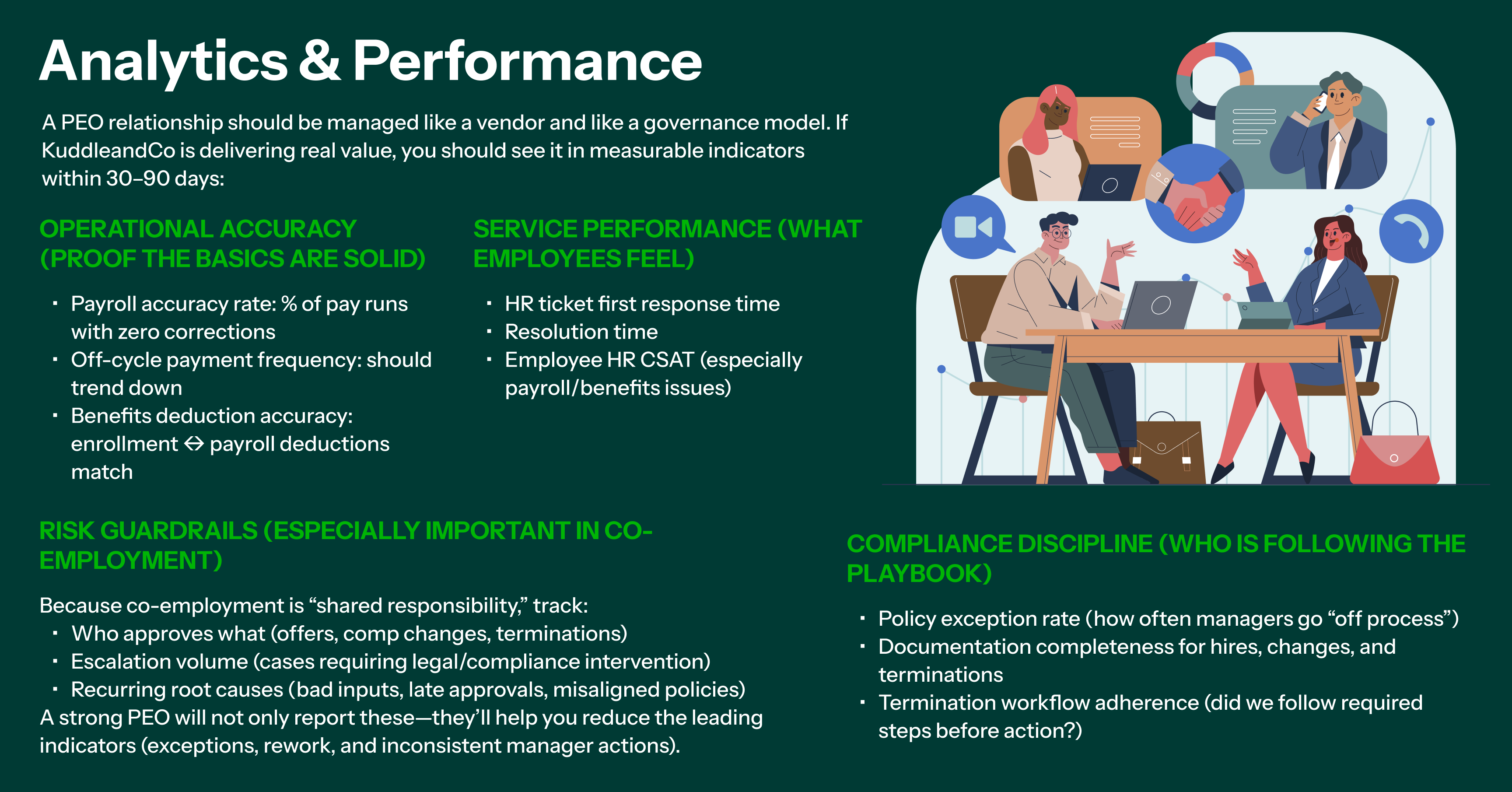
If you’re evaluating KuddleandCo, the smartest pre-sign move is to treat the agreement like a responsibility map: who does what, who is liable for what, what the SLAs are, and what reporting you’ll get—so co-employment becomes a control system, not a gray area.