
In 2026, the smartest companies don’t evaluate a PEO on “hours saved.” They evaluate it like an operating system for workforce control—one that should improve cost predictability, compliance risk, talent outcomes, and employee experience.
If you’re positioning KuddleandCo, the ROI story gets much stronger when you measure value across four buckets: hard savings, risk reduction, talent impact, and operational performance—not just admin relief.
Key Benefits

Hard-dollar savings (but measured correctly)
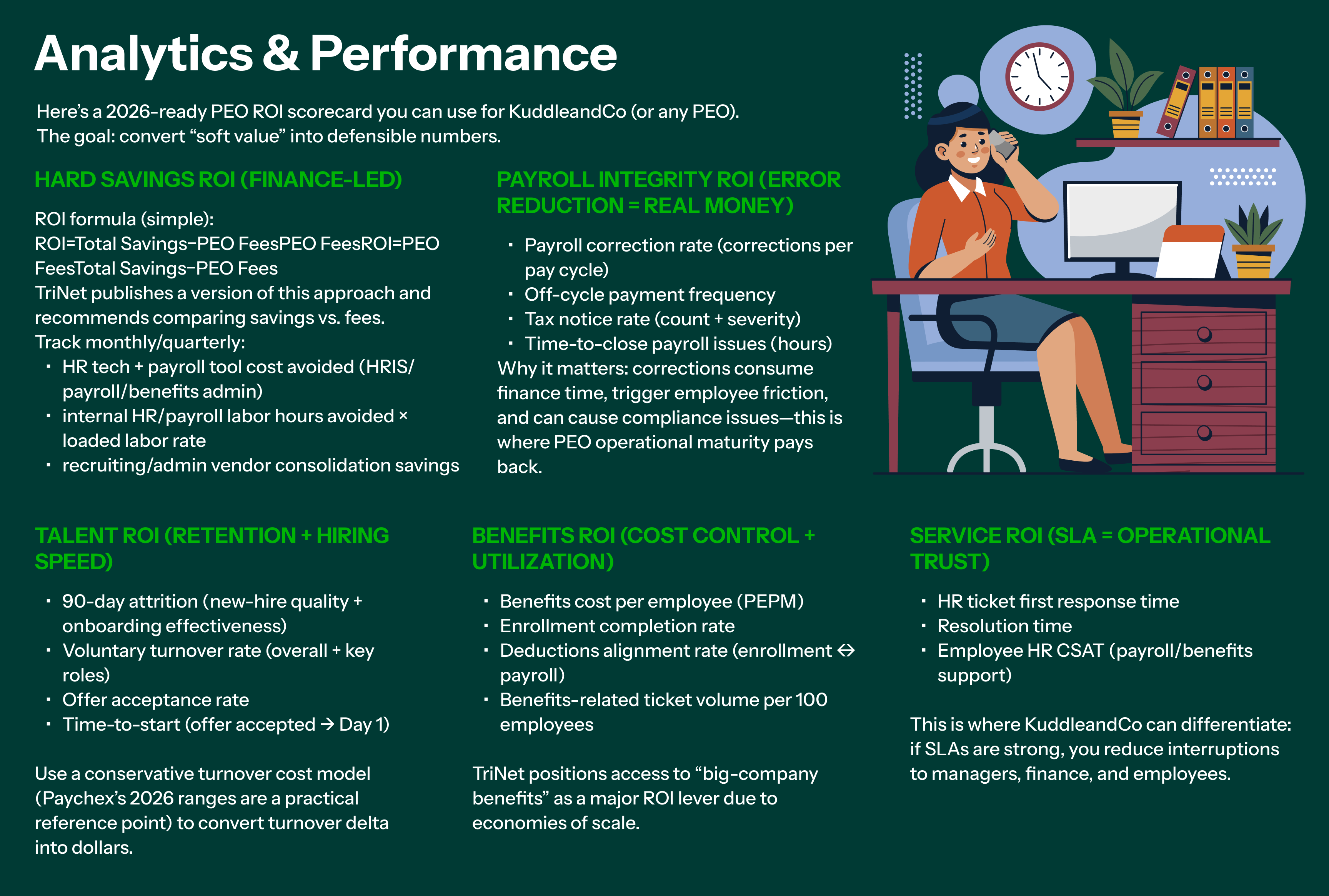
A credible baseline is hard cost savings vs. PEO fees—including payroll + HR tech + benefits admin + internal labor.
- TriNet’s ROI framing provides a simple ROI formula and highlights savings drivers like tech efficiency, turnover reduction, and benefits economies of scale.
- NAPEO’s ROI white paper reports an average ROI of 27.2% (based on hard cost savings), described as $1,272 saved per $1,000 spent, netting $272.
KuddleandCo angle: “KuddleandCo ROI isn’t just lower admin work—it’s measurable net savings after fees, powered by standardized workflows and fewer costly errors.”

Risk-adjusted ROI (compliance and employment tax exposure)
In 2026, compliance costs often show up as tax notices, penalties, retro corrections, and legal cleanups—not line items called “compliance.”
If you operate in the U.S., the CPEO (IRS Certified PEO) structure can materially affect employment tax liability mechanics. The IRS notes that, generally, a CPEO is solely liable for paying and filing employment taxes for wages it pays to work site employees (with nuances for non-worksite employees).
IRS guidance also highlights that CPEO certification can affect employment tax liabilities and how the CPEO is treated for employment tax purposes for covered workers.
Practical takeaway: ROI should include the expected value of risk reduced, not just payroll processing efficiency.

Talent ROI (retention and offer competitiveness)
PEO value often shows up in retention and benefits competitiveness—especially when the labor market is tight.
TriNet’s PEO ROI discussion references NAPEO findings that companies using PEOs can have materially lower turnover than national averages, and links retention to real replacement costs.
On the “what does turnover cost?” side, Paychex cites 2026 turnover cost ranges and encourages tracking turnover and cost-per-hire as core metrics.
KuddleandCo angle: “KuddleandCo strengthens total rewards execution (benefits, onboarding, HR support), which reduces early attrition and improves offer acceptance—two ROI levers bigger than admin savings.”

Experience ROI (employees feel payroll and benefits first)
Even if finance “saves money,” employees judge your HR engine by:
- payroll accuracy
- benefits enrollment clarity
- HR responsiveness
Those factors impact engagement and retention—and they’re measurable (see KPIs below). TriNet explicitly frames employee engagement and self-service as part of ROI through reduced frustration and improved experience.

Conclusion
In 2026, the best way to measure PEO ROI is to stop treating it as an admin shortcut and start measuring it like an operational control system:
- Hard savings (tools, labor, vendor consolidation)
- Risk-adjusted savings (tax/compliance exposure, especially under CPEO rules where relevant)
- Talent outcomes (turnover reduction, offer acceptance, time-to-start)
- Experience metrics (payroll accuracy, benefits clarity, HR responsiveness)
Position KuddleandCo around measurable outcomes: fewer payroll issues, lower attrition, tighter compliance controls, and executive-ready reporting—value that goes well beyond “lower admin work.”
References
- TriNet — PEO ROI
- TriNet — PEO Costs: Evaluating ROI
- NAPEO — The ROI of Using a PEO (PDF)
- IRS — CPEO customers: What you need to know
- IRS — Publication 15 (2026) Employer’s Tax Guide (CPEO note)