
In 2026, HR governance is evolving into a hybrid intelligence system—one that blends human judgment with AI-driven automation to manage workforce complexity at scale. Traditional HR governance focused heavily on policies, compliance enforcement, and administrative oversight. Today, it must also handle real-time decision-making, predictive risk management, and global workforce orchestration.
As organizations expand across borders and adopt AI-first operations, the governance function is becoming more strategic than operational. Companies working with providers like KuddleandCo are increasingly integrating AI-powered HR systems with structured workforce models such as PEO (Professional Employer Organization) and EOR (Employer of Record) to ensure both scalability and compliance.
Key Benefits of AI-Enhanced HR Governance

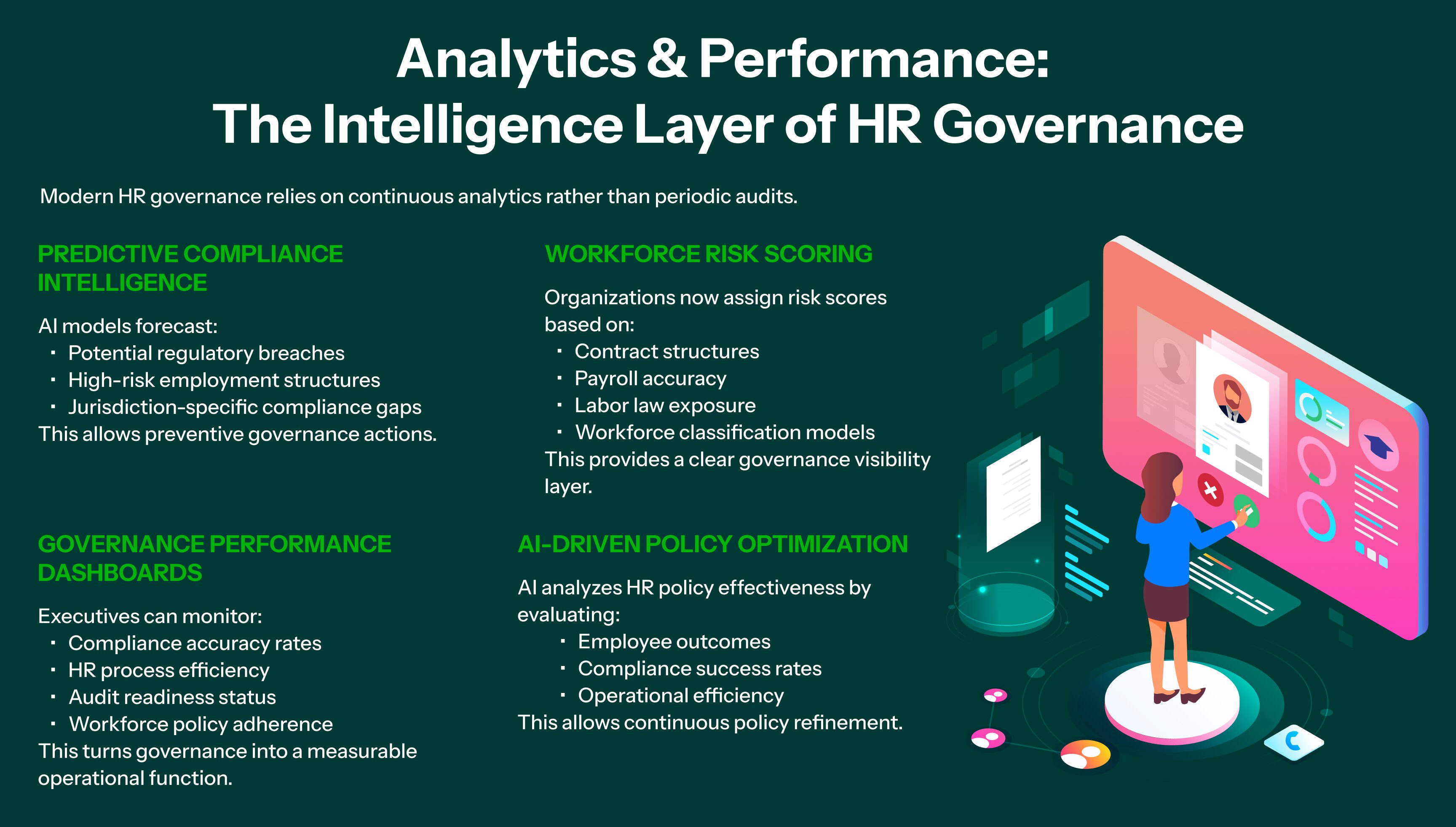
Real-Time Compliance Monitoring
AI continuously tracks:
- Labor law updates
- Employment classification rules
- Tax regulation changes
- Benefits compliance requirements
This enables proactive governance rather than reactive corrections.

Faster and More Accurate Decision-Making
AI supports HR leaders by analyzing:
- Workforce performance data
- Risk indicators
- Hiring trends
- Cost efficiency metrics
This allows governance teams to make faster, evidence-based decisions.

Standardized Global HR Policies
For multinational organizations, AI helps enforce consistent governance frameworks across:
- Multiple countries
- Remote teams
- Hybrid work environments
While still allowing localized compliance adjustments.

Reduced Operational Risk
AI identifies early warning signals such as:
- Payroll inconsistencies
- Misclassification risks
- Employee attrition spikes
- Compliance deviations
This significantly reduces legal and financial exposure.

Scalable Governance Structures
With AI automation and EOR/PEO frameworks, companies can scale HR governance without proportionally increasing administrative headcount.

Where Human Expertise Remains Essential
Even with advanced AI systems, human expertise remains the foundation of effective HR governance.
1. Ethical Decision-Making
AI can detect patterns, but humans determine what is fair, ethical, and culturally appropriate.
2. Legal Interpretation and Accountability
Regulatory interpretation and legal responsibility cannot be fully automated.
3. Organizational Culture and Leadership Alignment
Governance decisions must align with company values, leadership vision, and workforce culture.
The Role of PEO and EOR in HR Governance
PEO (Professional Employer Organization)
Supports:
- HR policy enforcement
- Payroll administration
- Benefits management
- Shared compliance responsibility
EOR (Employer of Record)
Enables:
- Legal employment in foreign markets
- Cross-border workforce governance
- Local labor law compliance
- Payroll and tax execution
Together, they ensure that governance frameworks are not just theoretical—but fully operational across global teams.
Organizations working with KuddleandCo benefit from combining AI-driven governance intelligence with structured PEO/EOR execution models.
How AI + Human Expertise + PEO/EOR Work Together
| Layer | Function | Example |
|---|---|---|
|
AI Layer |
Intelligence & monitoring |
Risk detection, analytics |
|
Human Layer |
Strategy & judgment |
Ethical decisions, leadership alignment |
|
Execution Layer (PEO/EOR) |
Compliance enforcement |
Payroll, legal employment |
This structure ensures governance is both intelligent and enforceable.
Conclusion
The future of HR governance is not about replacing human oversight with automation—it is about enhancing human decision-making with AI-driven intelligence and structured execution systems.
AI strengthens governance by improving visibility, speed, and predictive accuracy. Human expertise ensures ethical, strategic, and culturally aligned decision-making. PEO and EOR systems provide the legal and operational infrastructure needed to enforce governance across global teams.
Together, these elements create a modern HR governance model that is scalable, compliant, and future-ready.
With support from providers like KuddleandCo, organizations can transform HR governance into a dynamic, AI-enhanced system that supports global growth while maintaining full control and compliance.