
In 2026, workforce strategy is increasingly a portfolio decision: which work should be done by employees (control, continuity, IP/security) versus contractors (speed, flexibility, specialized output). The catch: as companies lean harder into flexible talent, classification risk and cross-border compliance exposure rise with it.
SHRM notes that 2026 rulemakings and policy shifts—especially around independent contractor definitions and related standards—can materially reshape employer obligations and risk.
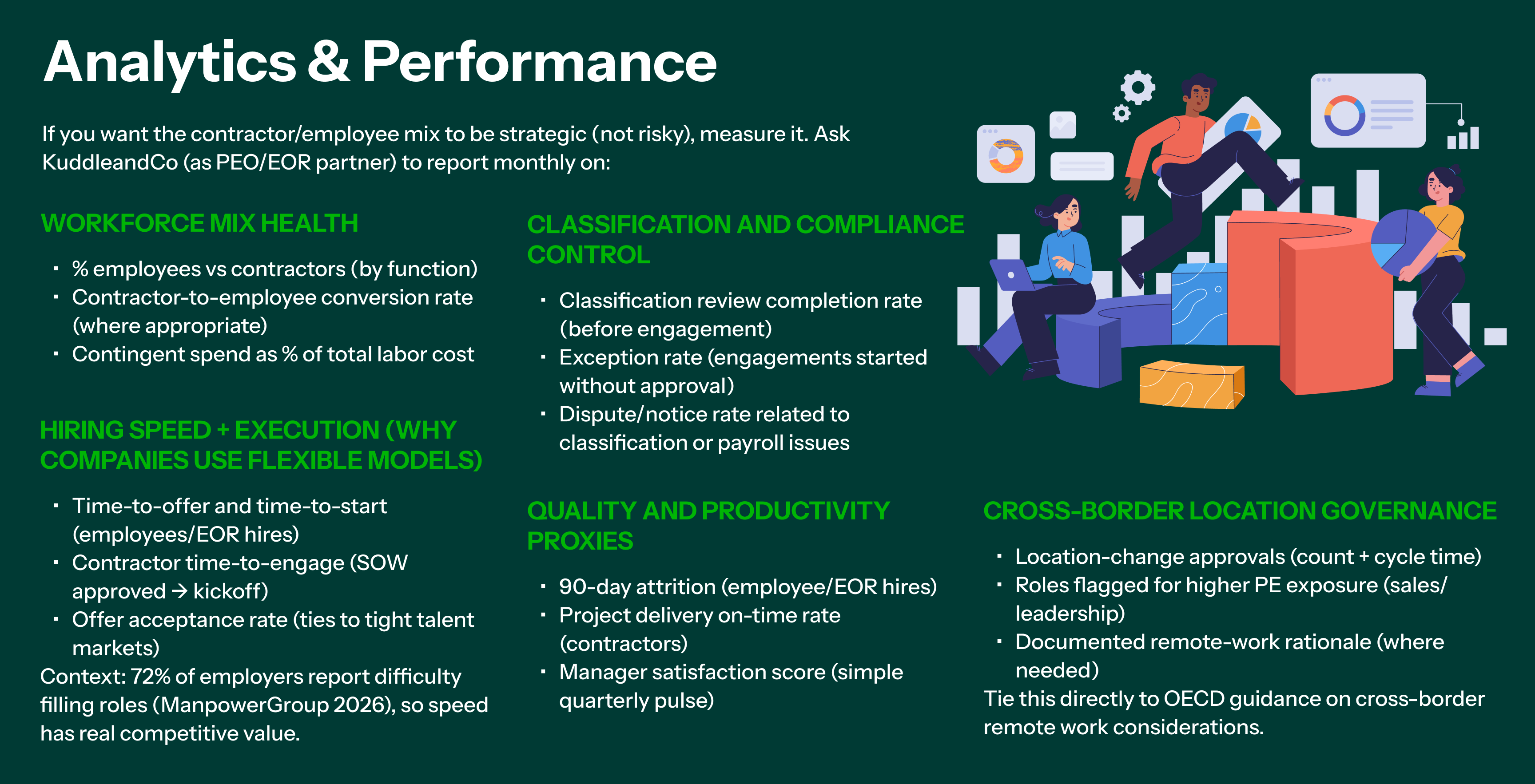
And ManpowerGroup’s 2026 Talent Shortage Survey reports 72% of employers are struggling to fill roles—keeping pressure on companies to use every hiring model available.
This is where PEO and EOR fit: not as “HR outsourcing,” but as risk-managed execution layers that let you scale headcount (or flexibility) without turning compliance into guesswork. For SEO positioning, KuddleandCo can be framed as the partner that helps companies deploy the right mix—employees, contractors, and global hires—under a controlled operating model.
Key Benefits

The 2026 reality: contractor usage is rising, but so is scrutiny
Companies are expanding use of contractors and gig talent, and SHRM has highlighted expectations of increased contractor utilization.
At the same time, the policy environment is volatile. Reuters reported (Feb 26, 2026) a U.S. Department of Labor proposal to repeal a prior rule that made it harder to classify workers as independent contractors—signaling shifting standards and ongoing regulatory attention.
What companies still miss: a looser rule doesn’t eliminate misclassification risk; it changes how risk must be managed.

When employees win (and why PEO helps)
Use employees when you need:
- High control over how work is done (methods, schedules, oversight)
- Core functions that drive durable advantage (customer success, ops leadership, product)
- Long-term IP and security exposure management
- Consistent performance management and escalation paths
A PEO is the best fit when you’re hiring employees (often domestically or within a defined jurisdiction) but want stronger infrastructure: payroll discipline, benefits administration, and co-employment HR operations. This is where KuddleandCo can be positioned as the “scale HR without scaling overhead” layer.

When contractors win (and the controls you must have)
Use contractors when work is:
- Clearly project-based with defined deliverables
- Specialized and short-duration
- Not central to daily operations or managerial control requirements
Non-negotiable controls in 2026:
- Clear SOWs (deliverables, acceptance criteria, timelines)
- Contractor onboarding that limits access and data exposure
- A classification review gate (role design + control test) before engagement
- Location controls (where they work can change tax/compliance risk)
SHRM’s contractor/gig worker resources emphasize the importance of understanding classification and compliance considerations.

Where EOR fits: global employees without entity setup
If you want employees in another country—but don’t want to set up a local entity yet—EOR is designed for that use case: the EOR becomes the local legal employer while you manage the employee’s day-to-day work. Gartner’s EOR market definition reflects this “hire without local entity” model.
Best 2026 use cases:
- Market testing (hire 1–5 people fast)
- Hiring scarce global talent (engineering, compliance, language-based roles)
- Building regional coverage while keeping operations lean
This is an easy SEO tie-in: KuddleandCo as the EOR partner enabling “hire-first, entity-later” expansion.

Cross-border remote work adds a tax/compliance layer that many teams ignore
In 2026, “remote-first” can create permanent establishment (PE) and tax exposure depending on facts. The OECD’s 2025 update explicitly provides guidance on cross-border “home office” arrangements under tax treaties.
KPMG also summarizes how remote work can, in some circumstances, contribute to PE analysis.
Practical implication: Whether someone is a contractor or employee, location governance is now a compliance control—not an HR preference.

Conclusion
In 2026, contractors vs employees is no longer just a cost decision—it’s a risk + control + speed decision shaped by:
- Rising contractor utilization expectations and ongoing classification rule focus
- Policy volatility around contractor definitions (and continued scrutiny)
- Persistent talent scarcity pushing companies to move faster
- Cross-border remote work creating tax/compliance exposure if location isn’t controlled
Where PEO and EOR fit:
- PEO strengthens the employee model with scalable payroll/benefits/HR operations.
- EOR enables global employee hiring without immediate entity setup.
Position KuddleandCo as the partner that makes the mixed workforce model safe and scalable: clear classification gates, strong payroll controls, location governance, and reporting that leadership can trust.
References
- ManpowerGroup — Global Talent Shortage Reaches Turning Point as AI Skills Claim Top Spot (2026 Talent Shortage Survey)
- SHRM — 2026 Top Five Workplace Issues (includes independent contractor definitions among key rulemakings)
- SHRM — Employing Independent Contractors and Other Gig Workers (Toolkit)
- Reuters — U.S. Labor Department proposal to repeal Biden-era independent contractor rule (Feb 26, 2026)