
In 2026, fast-growth teams don’t expand country-by-country the “traditional” way anymore (incorporate → open bank accounts → register payroll → hire). The new play is hire first, validate the market, then decide if you’ll build entities.
That’s exactly where an Employer of Record (EOR) fits: the EOR becomes the legal employer in the target country, runs compliant payroll/taxes/statutory benefits, and lets your company focus on productivity and go-to-market—without setting up a local entity upfront.
If KuddleandCo is part of your global hiring stack, this playbook helps you operationalize EOR expansion like a repeatable system.
Key Benefits

Speed-to-market without entity drag
Entity setup can take time and coordination (legal, finance, banking, registrations). An EOR model can compress your “first hire in-country” timeline because the EOR already has the local employing infrastructure in place.
Practical win: you can place a sales rep, implementation lead, or local ops hire quickly to prove demand before committing to an entity.

Built-in local employment compliance execution
EORs typically handle:
- locally compliant employment contracts,
- payroll processing and tax withholdings,
- statutory benefits and required filings,
- (often) work authorization support where relevant.
That’s the difference between “we found talent” and “we can actually employ them legally next month.”

Lower operational load for lean HR/Finance teams
For growth companies, the real bottleneck is often internal bandwidth. An EOR reduces the need to build local payroll operations country-by-country while still keeping day-to-day management with your team (you direct work; the EOR handles the employment admin).
Where KuddleandCo matters: you’re not just buying payroll—you’re buying repeatability across multiple countries.

Smart “test-and-invest” expansion strategy
Many companies use EOR as a market-entry bridge:
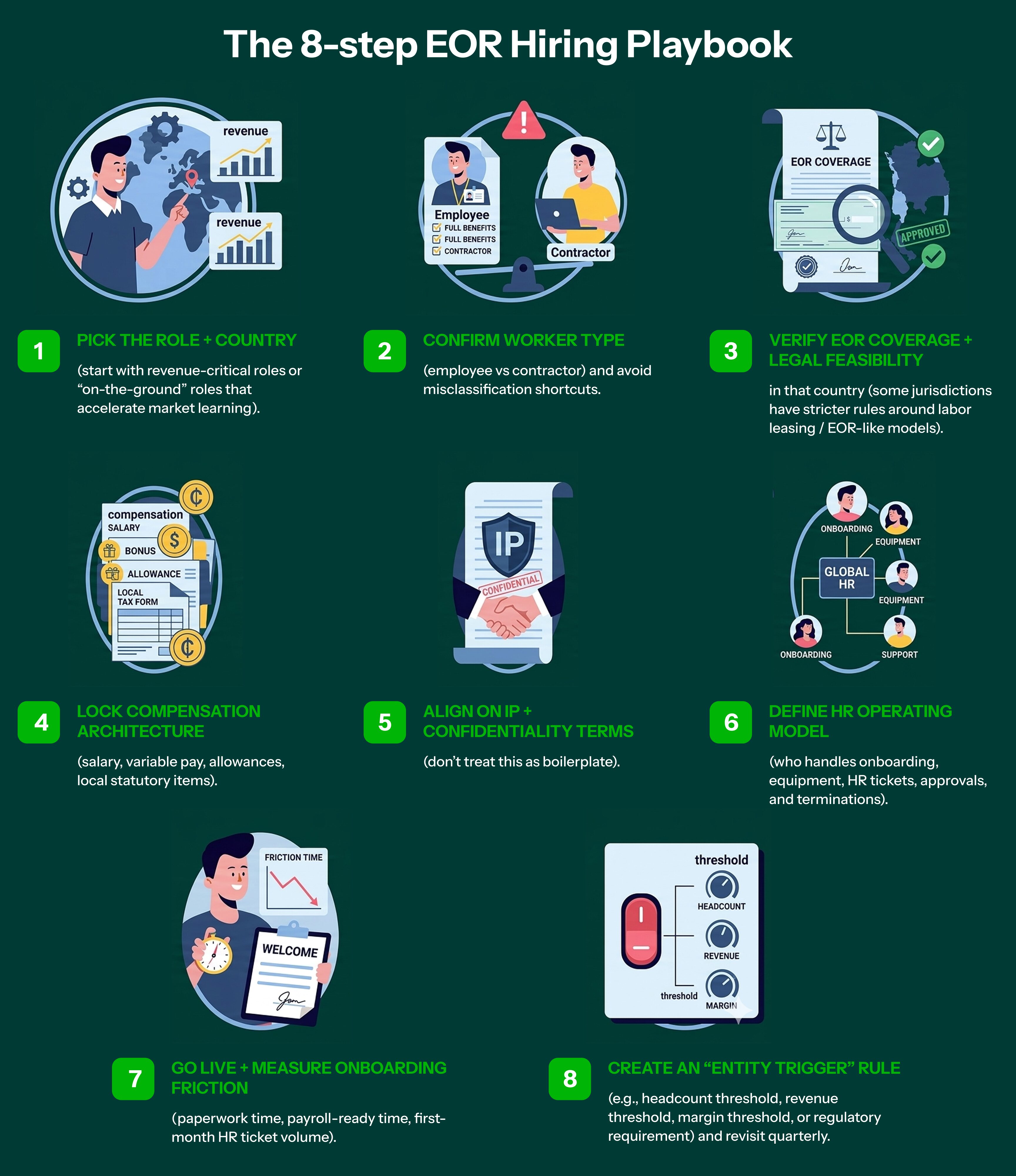
- EOR first to validate revenue, retention, and operational fit
- Entity later when headcount, margins, or regulatory needs justify it
This approach can prevent expensive entity buildouts in markets that don’t hit traction.

Clearer risk posture (but not “risk elimination”)
High-quality advisors (including major professional services firms) note EOR can make sense for entering a country without establishing a local presence for employment-law purposes—yet companies still need to manage governance, oversight, and structure thoughtfully.
Also: EOR does not magically remove permanent establishment (PE) risk if your business activities in-country create taxable presence. Treat any vendor promising “PE-proof” expansion as a red flag.

Analytics & Performance
Speed KPIs (market-entry velocity)
- Time-to-offer → start date (by country)
- Payroll-ready cycle time (contract signed to first compliant payroll)
- Offer drop-off rate due to benefits/admin delays
Target effect: EOR should reduce time-to-start in new countries versus entity-first expansion.
Compliance + payroll quality KPIs (operational stability)
- Payroll error rate (missed/incorrect payments, tax issues)
- Compliance incident count per quarter
- HR case resolution time (tickets involving contracts, benefits, statutory items)
EORs are expected to own core compliance execution as the legal employer, so these metrics should improve when the model is functioning properly.
Cost + predictability KPIs (finance-friendly scaling)
- Fully loaded cost per employee (salary + statutory + benefits + EOR fees)
- Forecast variance (% actual vs forecast)
- Country launch cost compared with entity setup projections
Employee experience KPIs (retention insurance)
- New-hire onboarding satisfaction
- Benefits satisfaction and utilization
- HR ticket volume per employee (first 60 days)
BambooHR’s guidance on global hiring without an entity highlights that an EOR manages payroll/benefits/compliance while you manage day-to-day—so your employee experience depends heavily on how clean that handoff is.
“When to switch to an entity” performance triggers
Common triggers to consider:
- You’re hitting a stable headcount in-country (and the unit economics justify it)
- You need deeper commercial capabilities (contracts, invoicing, local procurement)
- Regulatory/compliance constraints make EOR less ideal long-term
- You want direct control over benefits design and HR policy
Transitions require planning (contracts, employee transfer obligations, payroll migration). Don’t treat it as a quick vendor flip.
Conclusion
In 2026, EOR isn’t a “nice-to-have”—it’s a market-entry operating system for fast-growth companies. Used well, it lets you hire in new countries quickly, stay compliant, and validate markets before investing in entities.
If you’re building a repeatable expansion motion with KuddleandCo, the winning approach is:
- standardize your EOR launch steps,
- measure performance like a growth channel, and
- set clear triggers for when to graduate to an entity—so your global footprint scales without chaos.