
In 2026, Professional Employer Organizations (PEOs) are moving from “nice-to-have HR support” to a growth infrastructure decision. Two forces are driving the shift:
- Compliance complexity is rising (more rules, more penalties, more cross-functional risk).
- Talent competition is staying stubbornly tight, especially for scarce skills.
For fast-growth teams, a modern PEO like KuddleandCo can help absorb operational strain—so leadership can focus on scaling revenue, not scaling HR headaches.
Key Benefits

Compliance risk reduction at scale
Regulatory change doesn’t just affect HR—it spills into finance, IT security, and operations. Compliance trends have increasingly emphasized areas like cybersecurity exposure, leave law variations, and automation-related risk controls—issues that HR teams must operationalize quickly.
A PEO helps by standardizing the essentials:
- Payroll tax administration and reporting
- Policy alignment (handbooks, leave workflows, employee classification guidance)
- Documentation discipline (auditable processes that reduce “tribal knowledge” risk)
If you’re hiring in the U.S., the IRS Certified PEO (CPEO) framework also signals how seriously the market treats payroll-tax accountability and financial rigor (bonding, compliance, reporting requirements).

Better benefits to win talent (without enterprise spend)
When talent is scarce, benefits and total rewards become a differentiator, not a perk. PEOs often help employers access more competitive benefits options and improve enrollment/admin execution—key levers for recruiting and retention.
This matters because talent shortages are still widespread in 2026. ManpowerGroup’s 2026 survey shows over seven in ten employers report difficulty finding the talent they need.

Faster hiring execution (less HR bottleneck)
In fast growth, HR becomes a throughput constraint:
- offers delayed
- onboarding inconsistent
- payroll setups rushed
- policies applied unevenly
A PEO operating model reduces friction by providing repeatable processes, templates, and support capacity—so hiring doesn’t slow when headcount ramps.

HR operational maturity—so leaders can focus
PEOs don’t just “do admin.” In 2026, the expectation is HR-as-operations:
- clean employee data
- consistent workflows
- reliable reporting
- fewer surprises at payroll and audits
For scaling companies, KuddleandCo can be positioned as a partner that brings structure—without requiring you to build a large internal HR department first.
Practical dashboard sections to request from your PEO
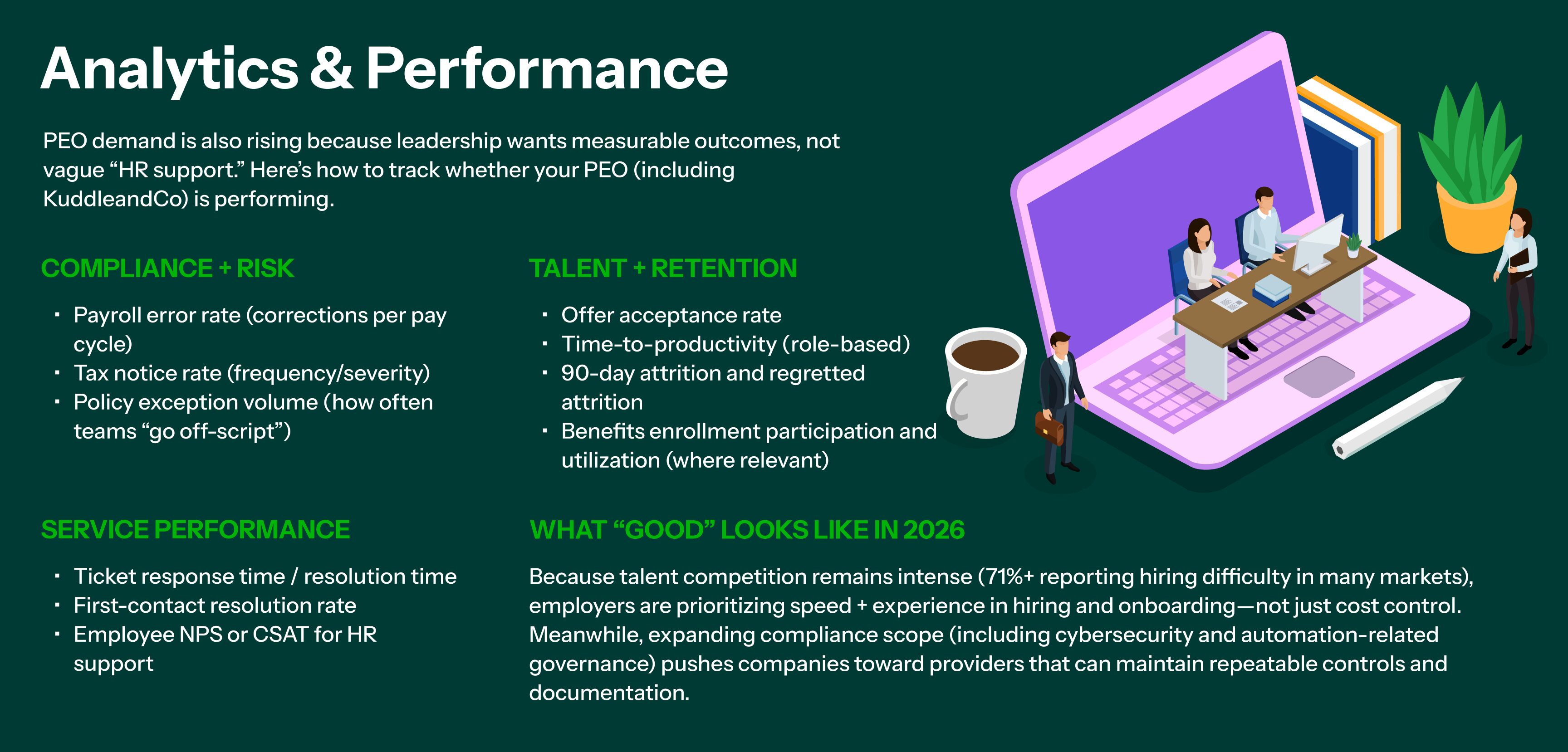
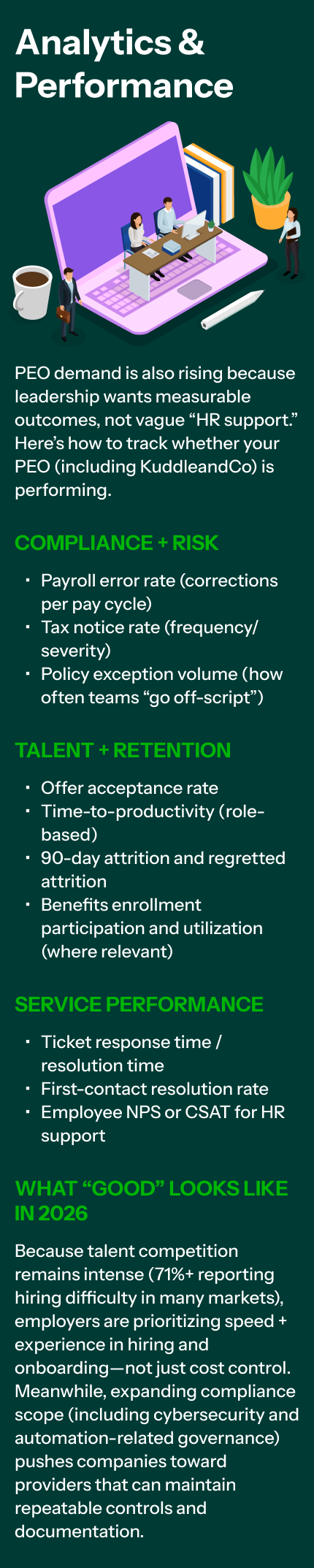
Ask KuddleandCo (or any PEO) for a monthly dashboard that includes:
- Payroll accuracy summary (errors, root causes, resolution times)
- Compliance events log (notices, investigations, escalations, preventive actions)
- Hiring/onboarding throughput (cycle times, bottlenecks)
- Benefits + retention signals (participation, turnover hot spots)
- Service-level reporting (SLA adherence, recurring issues)
Conclusion
PEO demand is rising in 2026 because the market is rewarding companies that can do two things at once:
- Stay compliant in a world where rules and risk surfaces keep expanding, and
- Compete for talent where scarcity remains the norm, especially for high-impact skills.
A PEO like KuddleandCo isn’t just an HR vendor—it’s an operating system for scaling: risk controls, benefits competitiveness, and HR execution discipline. The winners in 2026 will be the firms that treat HR infrastructure like a growth lever, not a back-office afterthought.
References
- ManpowerGroup – 2026 Global Talent Shortage
- ManpowerGroup Vietnam – 2026 Global Talent Shortage Survey (APME highlights)
- SHRM – HR Workplace Compliance Trends to Watch in 2025
- IRS – Certified Professional Employer Organization (CPEO)
- IRS – About Certified Professional Employer Organization (CPEO)