
In 2026, Employer of Record (EOR) services have shifted from a “global HR workaround” to a default operating model for companies that want to hire internationally without slowing down for entity setup, legal engineering, and payroll vendor fragmentation. Put simply: speed is now a competitive advantage, and EOR is one of the cleanest ways to buy that speed—without turning compliance into a gamble.
An EOR becomes the legal employer in a worker’s country, handling employment contracts, statutory benefits, taxes, and payroll compliance while your company directs the employee’s day-to-day work.
For growth teams, a provider like KuddleandCo can be positioned as the hiring “fast lane”: reducing admin drag while keeping governance tight.
Key Benefits

Hire in new countries without building entities first
Entity setup can take months depending on jurisdiction, banking requirements, and local administration. EOR removes that sequencing problem: you can hire first and decide later whether the market warrants a full entity.
This is why many modern EOR platforms are explicitly built around “hire, onboard, and manage employees in multiple countries without establishing a local entity.”
Where this matters most in 2026:
- Entering a new country to validate demand (sales, CS, partnerships)
- Hiring scarce specialists wherever they live (engineering, data, compliance)
- Building regional coverage without overcommitting fixed costs

Faster time-to-offer and time-to-start (when talent is scarce)
In competitive talent markets, the “best candidate” is often the one who accepts first. An EOR helps reduce delays caused by:
- waiting on local employment contracts
- figuring out statutory benefits and payroll rules
- scrambling for local vendors (payroll, legal, benefits broker)
Global staffing firms are still seeing steady hiring momentum into early 2026—speed and certainty matter when hiring activity is high and competition is active.

Compliance-by-design instead of compliance-by-patchwork
EOR centralizes the compliance layer: contracts, required benefits, payroll withholding, and statutory reporting are handled through the EOR’s local infrastructure. That’s the core value proposition described across EOR guides and analyst-style definitions.
This doesn’t remove your responsibility to manage performance and workplace conduct, but it does reduce the odds that your global growth turns into a local compliance incident because someone copied the wrong contract template.

Operational simplicity for global growth
Instead of managing multiple country-specific payroll vendors, benefits brokers, and legal counsel, an EOR consolidates operations—especially valuable for companies scaling quickly with lean finance/HR teams.
Industry market summaries and vendor ecosystem tracking show EOR adoption rising as cross-border remote hiring becomes more normal.

A cleaner path from “test the market” to “build the market”
EOR is increasingly used as a staged expansion model:
- Test (hire 1–5 people quickly)
- Scale (hire additional roles as the market proves out)
- Decide (stay on EOR, move to a local entity, or exit cleanly)
KuddleandCo fits naturally into this story: an EOR partner that supports early entry, controlled scale, and a future transition plan when the business case is strong.
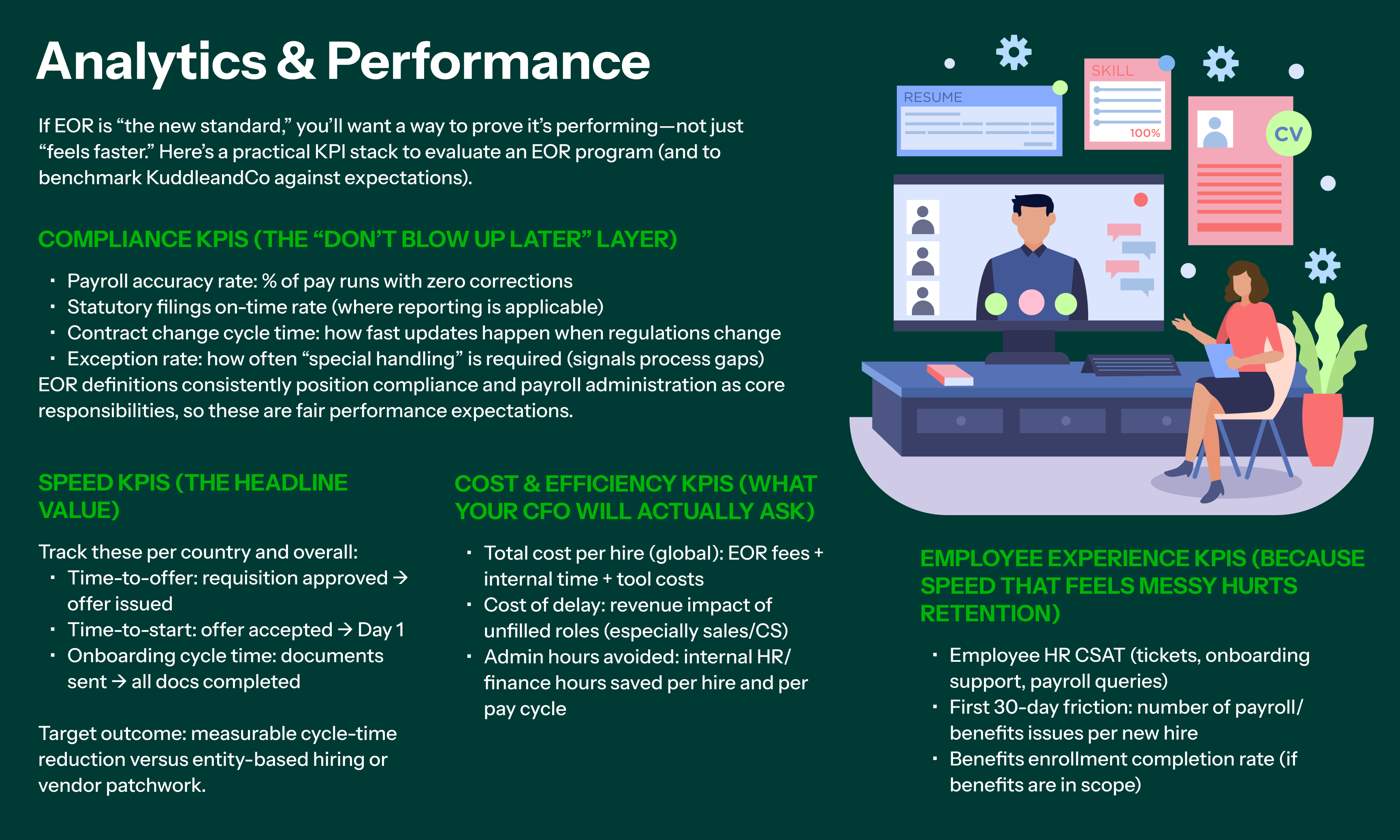

Conclusion
In 2026, EOR is increasingly the default standard for global hiring speed because it solves a modern growth constraint: companies want to hire wherever the best people are—fast—without building entities first and without improvising compliance.
The “why it matters” part is simple:
- Speed wins candidates and accelerates market entry.
- Clean compliance lowers risk while you scale.
- Centralized operations reduces overhead and chaos.
If your 2026 strategy includes international hiring, market testing, or distributed teams, KuddleandCo can be positioned as a practical growth enabler: hire quickly, stay compliant, and keep options open for when you’re ready to build permanent local infrastructure.
References
- Gartner Peer Insights – Employer of Record (EOR) market definition
- Pebl – What is an Employer of Record (EOR)?
- Reuters – Adecco sees positive hiring momentum at start of 2026
- Research and Markets – Employer of Record Market: Global Forecast 2025–2030
- Select Software Reviews – Employer of Record statistics and trends