
Global hiring in 2026 is moving faster than ever—but compliance hasn’t gotten simpler. The biggest risks aren’t usually the obvious “we forgot to run payroll” problems. They’re the second-order issues that show up after you’ve already hired: classification decisions, cross-border tax exposure, AI-in-HR rules, and messy offboarding that triggers disputes.
A good partner like KuddleandCo (PEO/EOR support, depending on your model) reduces this risk by turning compliance into an operating system: clear policies, strong documentation, and measurable controls—not guesswork.
Key Benefits

Worker misclassification (the risk that keeps surviving every trend cycle)
Even in 2026—after years of enforcement—misclassification is still a top compliance risk, especially as remote and cross-border work expands. Payroll and compliance experts continue to flag it as one of the most pressing issues.
What companies miss:
- Treating “contractor” as a procurement decision instead of a legal test
- Letting managers freelance role design without HR/legal guardrails
- Assuming an EOR/PEO automatically “fixes” classification without proper scoping
How KuddleandCo can reduce risk: standardized classification intake, country/state-specific rules-of-thumb, and enforced documentation before onboarding.

Permanent Establishment (PE) risk from remote workers
Teams often think PE is a “big company problem.” In 2026, it’s increasingly a remote-work problem: a single remote worker in another country can create tax exposure depending on facts and local rules.
The OECD has issued updated guidance on how remote work can contribute to PE analysis, and major advisory firms have highlighted this as a key cross-border risk area.
What companies miss:
- Allowing “work from anywhere” without tax review
- Salespeople operating abroad without understanding agency/PE triggers
- Treating location changes as an HR issue, not a tax + legal issue
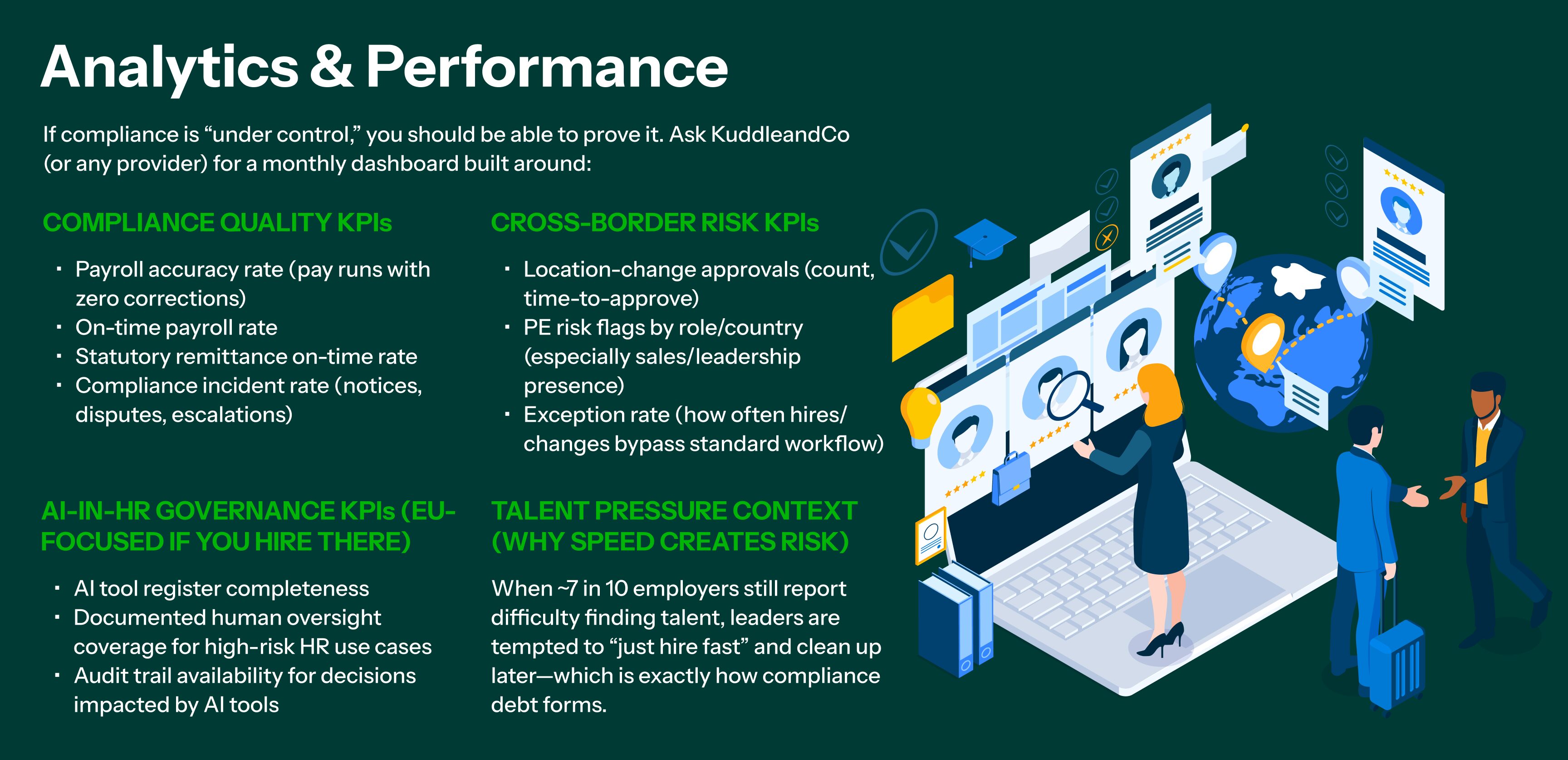
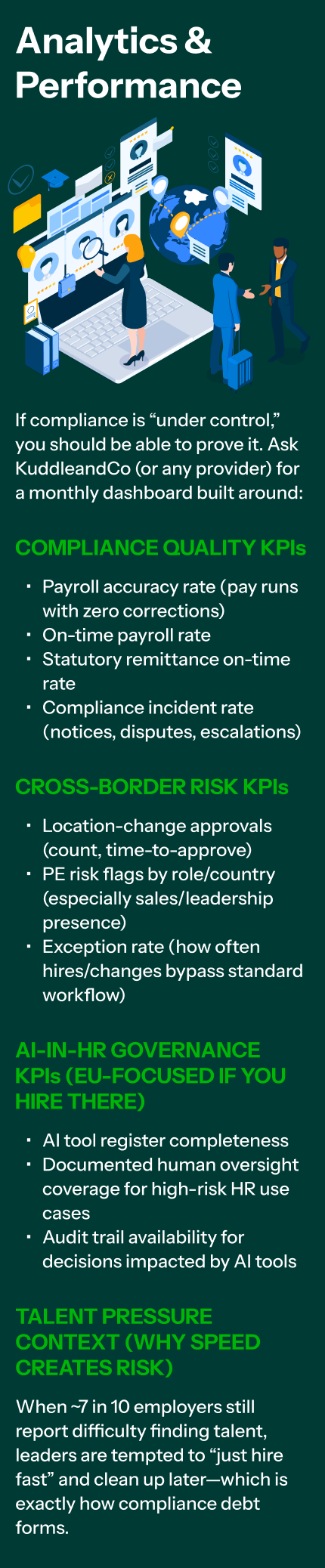
What “top providers” do: require location-change approval workflows and maintain PE risk flags by role/location.

AI-in-HR compliance (especially in the EU) is becoming enforceable reality
In 2026, many HR AI use cases (screening, selection, evaluation) are likely to be treated as high-risk under the EU AI Act, which brings governance requirements like documentation, human oversight, and monitoring.
There’s also policy flux: Reuters reported the EU Commission proposed delaying “high-risk” AI rules to December 2027 (from an earlier August 2026 timeline). So, you need a plan that works even if timelines shift.
What companies miss:
- Using AI tools in recruiting without an audit trail
- Not knowing whether their tools qualify as “high-risk”
- No human-override procedure or transparency plan for candidates/employees
How KuddleandCo can help: bake AI governance into hiring workflows (tool register, approvals, documented human oversight).

Payroll tax + statutory contribution errors (especially across borders)
Global growth creates “silent failures”: wrong withholding, missed filings, late remittances, and mismatched statutory contributions. That’s why payroll teams are emphasizing stronger tax compliance controls in 2026.
What companies miss:
- Cross-border hires being approved before payroll/tax setup is ready
- Retro changes and allowances handled informally (then corrected later)
- Weak change-control for comp/benefit updates that affect deductions
What top providers do: enforce payroll calendars, cutoffs, approval workflows, and exception handling with reporting.

Termination + offboarding mistakes (where risk concentrates)
Hiring is the fun part. Offboarding is where compliance disputes are born. Countries vary widely on notice, final pay, severance triggers, documentation, and dispute resolution norms. Even with an EOR, clients can create risk by making decisions without following local process.
What companies miss:
- Treating termination as “one global policy”
- No performance documentation standard
- Final pay and benefits wrap-up not aligned with local rules
What “good” looks like: a termination playbook per country, with required steps and timelines, and escalation gates for higher-risk cases.
Conclusion
In 2026, the biggest global employment risks companies still miss aren’t exotic—they’re operational:
- Misclassification that persists because hiring moves faster than governance
- Permanent establishment exposure triggered by remote work and local activity
- AI-in-HR compliance (especially EU AI Act “high-risk” obligations) that needs real controls, not policy statements
- Payroll/statutory compliance failures caused by weak change management
- Offboarding mistakes that turn routine exits into disputes
A provider like KuddleandCo reduces these risks when it operates like a compliance system: standard workflows, strong documentation, measurable SLAs, and reporting—so you can scale globally without accumulating hidden compliance debt.
References
- ManpowerGroup — 2026 Global Talent Shortage
- ManpowerGroup Vietnam — 2026 Talent Shortage Survey (APME: 71% difficulty filling roles)
- Thomson Reuters — Payroll teams strengthening tax compliance in 2026 (misclassification focus)
- European Commission — AI Act overview + high-risk timeline
- Crowell — AI & HR in the EU: 2026 legal overview