
In 2026, Employer of Record (EOR) has become a mainstream model for international hiring—but compliance isn’t automatic just because you’re using an EOR. The best providers reduce employment risk by combining local legal infrastructure + disciplined operational controls + audit-ready documentation, while keeping the client (you) clear on what responsibilities still stay in-house.
For growth teams, an EOR like KuddleandCo should be positioned as more than a hiring shortcut: it’s a risk-management operating layer that helps you expand without turning employment compliance into a guesswork exercise.
Key Benefits

Local-law contracts that protect the business (not just “template compliant”)
Top EORs don’t just issue a local contract—they ensure it includes the business protections companies often forget when hiring abroad (confidentiality, IP assignment, return of property, post-termination clauses where enforceable). PwC specifically flags these as critical issues to address when using EORs.
What KuddleandCo should deliver here
- Country-specific contract logic (probation, notice, termination mechanics)
- Local enforceability checks for key clauses (IP/confidentiality/restrictions)
- A change-control process when laws update (not “we’ll fix it later”)

Payroll tax withholding + statutory contributions done correctly, on time
One of the biggest employment risks in global expansion is simple: wrong withholdings, missed filings, late remittances, and incorrect statutory contributions.
The IRS notes employers are responsible for withholding/filing employment taxes and explains how many employers outsource payroll tax duties to third-party payer arrangements.
(Globally, the same principle applies: payroll compliance failures become penalties + employee trust issues.)
What top EORs standardize
- Payroll calendars, cutoffs, and approval workflows
- Automated contribution calculations + remittance tracking
- Exception handling (retro pay, reimbursements, off-cycle runs)

Clear separation of “legal employer” vs “common-law employer” risk
A recurring 2026 pitfall: companies assume the EOR absorbs all employment risk. In reality, authorities can look at who controls the work when determining employer-employee relationships under common-law rules.
This is why top providers explicitly educate clients on:
- What the EOR covers legally (contract, payroll, statutory compliance)
- What the client still controls operationally (day-to-day direction, performance management, workplace conduct)
Many EOR explainers highlight this split: EOR handles payroll/taxes/benefits/compliance while the client manages day-to-day work.
KuddleandCo positioning tip: frame KuddleandCo as the partner that prevents “shadow employer” mistakes through client training, playbooks, and documented workflows.

Strong termination and offboarding governance (where risk spikes)
Terminations are where risk concentrates: notice periods, final pay rules, required documentation, and local dispute norms vary dramatically. Top EORs reduce risk by enforcing:
- documented performance trails and warnings (when needed)
- correct notice/severance mechanics
- compliant final pay and benefits wrap-up
PwC explicitly calls out “ask the critical compliance questions” and “protect business interests” when using EORs—termination is a major part of that.

Country-ready compliance operations (not just “global platform marketing”)
Strong EORs operate like a compliance system:
- local employment agreements
- payroll + tax withholding/remittance
- statutory benefits administration
- labor-law adherence (working time, leave, mandatory payments)
That’s the baseline model described by multiple EOR definitions.

Conclusion
In 2026, “using an EOR” isn’t the same as being protected. The top providers reduce employment risk by doing five things consistently:
- issuing locally enforceable contracts with real business protections
- running accurate payroll + statutory remittances with tight controls
- preventing confusion between legal employer and common-law control realities
- governing high-risk moments like termination and final pay
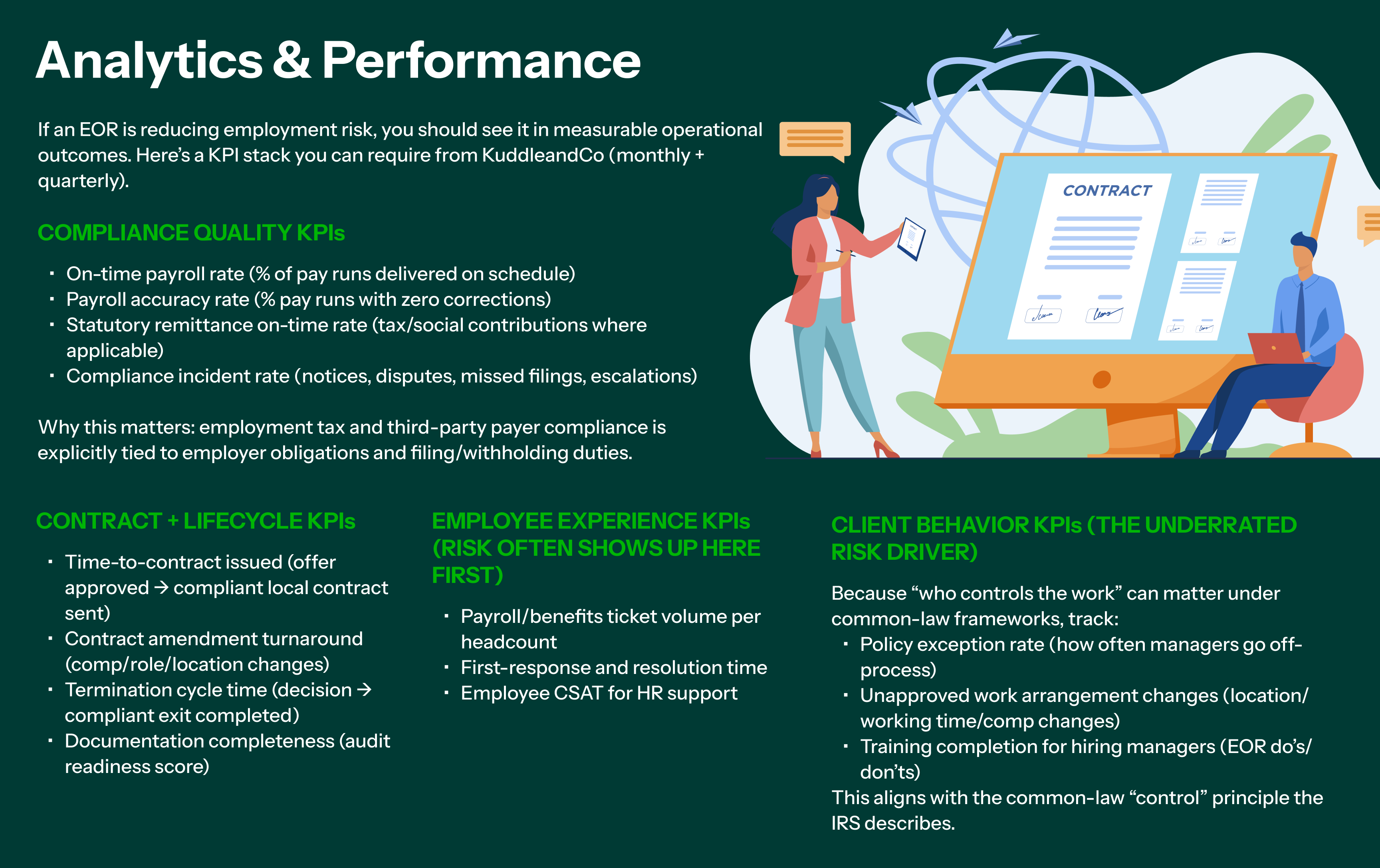
- producing audit-ready reporting that proves compliance is working, not assumed
If you’re positioning KuddleandCo in this space, make the promise concrete: risk reduction you can measure—with dashboards, SLAs, and documented controls that scale as fast as your global hiring does.
References
- PwC — The pros and cons of employers of record
- IRS — Third party payer arrangements (PEOs and common law employer context)
- IRS — Employee (common-law employee)
- Atlas — Employer of Record: compliant contracts, payroll, statutory benefits, tax filings
- TopSource Worldwide — Employer of Record definition (contracts, payroll, taxes, social contributions)