
Expansion in 2026 doesn’t usually fail because leaders “didn’t hire HR.” It fails because the true cost of in-house HR during growth is rarely captured in the budget. Payroll errors, compliance cleanups, benefits volatility, tool sprawl, and slow hiring cycles all add friction—then compound as headcount climbs.
This is where a PEO (Professional Employer Organization) can outperform building everything internally. A modern partner like KuddleandCo can consolidate payroll, benefits administration, and HR operations into a repeatable system—often saving more than the visible PEO fee because it reduces the hidden costs that expansions quietly bleed.
Key Benefits

You avoid “HR stack sprawl” (and its ongoing maintenance cost)
Scaling in-house usually means buying and stitching together:
- HRIS
- Payroll software
- Benefits administration
- Time tracking
- Compliance documentation workflows
- Reporting and audit trails
Even if each tool looks inexpensive alone, the real cost is the integration + admin burden: data syncing, permissions, onboarding workflows, and constant updates. PEO models reduce this by providing a more unified operating layer and standardized processes.
Why it matters in 2026: speed and accuracy win. Fragmented tools create payroll and onboarding mistakes that hurt employee trust and waste finance time.

You reduce payroll tax and compliance exposure (the “penalty + cleanup” tax)
During expansion, compliance risk grows faster than headcount because teams create exceptions:
- special pay arrangements
- multi-location rules
- inconsistent documentation
- rushed onboarding
A PEO can impose standardized workflows and, in the U.S., CPEO (IRS Certified PEO) status has specific implications for employment tax responsibility—one reason many buyers view certification as a risk-reduction signal.
KuddleandCo angle for SEO: position KuddleandCo as the PEO that brings “growth-grade controls”—policy consistency, payroll accuracy discipline, and clean documentation.

You access benefits leverage that’s hard to replicate in-house
For many growing companies, benefits costs rise because they lack:
- buying leverage
- plan design expertise
- enrollment/admin capacity
PEOs often aggregate buying power and streamline benefits administration, which can reduce premiums and cut internal workload—especially for companies that are not yet large enough to negotiate like enterprises.

You protect hiring velocity when talent competition is still intense
Hiring delays are a hidden cost. When offers take too long because HR ops are overloaded (contracts, onboarding, payroll setup), candidates drop—and business plans slip.
In 2026, talent pressure remains real: ManpowerGroup’s 2026 survey reports 72% of employers have difficulty filling roles (and AI skills are among the hardest to find).
A PEO doesn’t replace recruiting, but it can reduce the operational drag that slows down starts.

You lower the cost of mistakes (bad hires, turnover, rework)
The “expansion tax” includes mistakes you don’t see on a P&L line item:
- misclassified roles
- poor onboarding → early attrition
- inconsistent policies → disputes and manager time loss
- payroll errors → employee dissatisfaction and rework
Some workforce research commonly cites that a bad hire can cost around 30% of first-year earnings (and higher for specialized roles), highlighting how quickly hiring mistakes become expensive.
A PEO helps by standardizing onboarding, documentation, and manager guidance—reducing preventable errors.
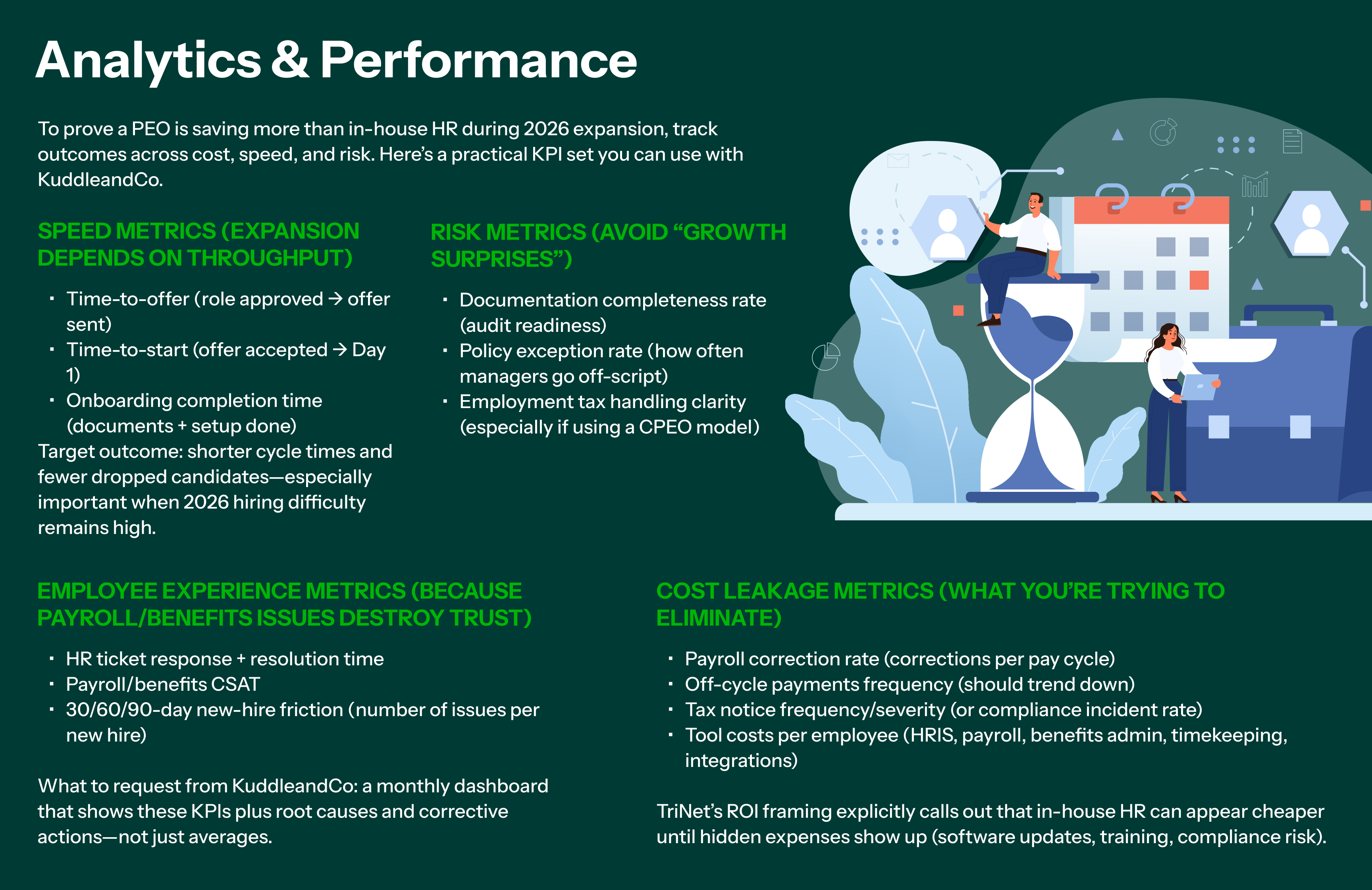

Conclusion
In 2026 expansion, the hidden costs aren’t just HR salaries—they’re tool sprawl, compliance cleanup, payroll rework, benefits volatility, and hiring delays. A PEO can save more than in-house HR when it:
- reduces compliance and payroll-tax exposure through standardized controls (and, where relevant, CPEO-grade rigor)
- consolidates HR operations and benefits administration to cut fragmentation costs
- protects hiring velocity in a market where 72% of employers still struggle to fill roles
If your growth plan for 2026 includes rapid hiring, multi-location complexity, or lean internal ops, KuddleandCo can be positioned as the PEO partner that turns HR from a bottleneck into a scalable control system—often delivering savings that don’t show up until you compare the total cost of expansion.
References
- ManpowerGroup — Global Talent Shortage Reaches Turning Point (2026 survey press release)
- ManpowerGroup — 2026 Global Talent Shortage (report page)
- IRS — Certified Professional Employer Organization (CPEO)
- IRS — CPEO customers: what you need to know
- TriNet — PEO Costs: Evaluating ROI (hidden in-house expenses)