
As companies scale globally in 2026, one of the most critical strategic decisions is timing the transition from an Employer of Record (EOR) model to establishing a local legal entity with in-house HR operations. While EOR solutions offer speed and flexibility, long-term growth often demands deeper operational control, cost efficiency, and localized capability.
For organizations like KuddleandCo, this decision marks a major inflection point in international expansion maturity—moving from “market testing” to “market ownership.”
Key Triggers to Transition from EOR to Entity + In-House HR

Sustained Headcount Growth in a Single Market
A primary signal is when a country consistently grows beyond a small, experimental team.
- EOR is ideal for 1–20 employees per market
- Beyond that, per-employee EOR fees become less cost-efficient
- High-growth markets justify entity formation for scale optimization

Rising Employment Cost Inefficiency
EOR pricing includes administrative and compliance premiums. At scale, these accumulate significantly.
- Entity setup reduces per-employee overhead
- Payroll becomes more cost-controlled internally
- HR operations become an investment rather than a service cost

Need for Strategic HR Ownership
Companies eventually require deeper integration of HR into business strategy.
- Custom compensation structures
- Internal performance management systems
- Stronger employer branding in local markets
- Direct control over culture-building and retention

Regulatory or Industry Complexity
Certain industries or countries impose constraints that make EOR less ideal long-term.
- Sector-specific compliance requirements
- Restrictions on contractor/EOR usage
- Licensing or operational requirements tied to legal entities

Expansion Stability (Market Maturity)
Switching makes sense when a market is no longer experimental but a core revenue driver.
- Predictable revenue streams in-country
- Established sales pipeline and customer base
- Long-term commitment to the region
Conclusion
The shift from EOR to entity + in-house HR is not just an administrative change—it is a strategic milestone in global expansion maturity. In 2026, companies that master this transition effectively gain stronger cost control, deeper market integration, and long-term operational independence.
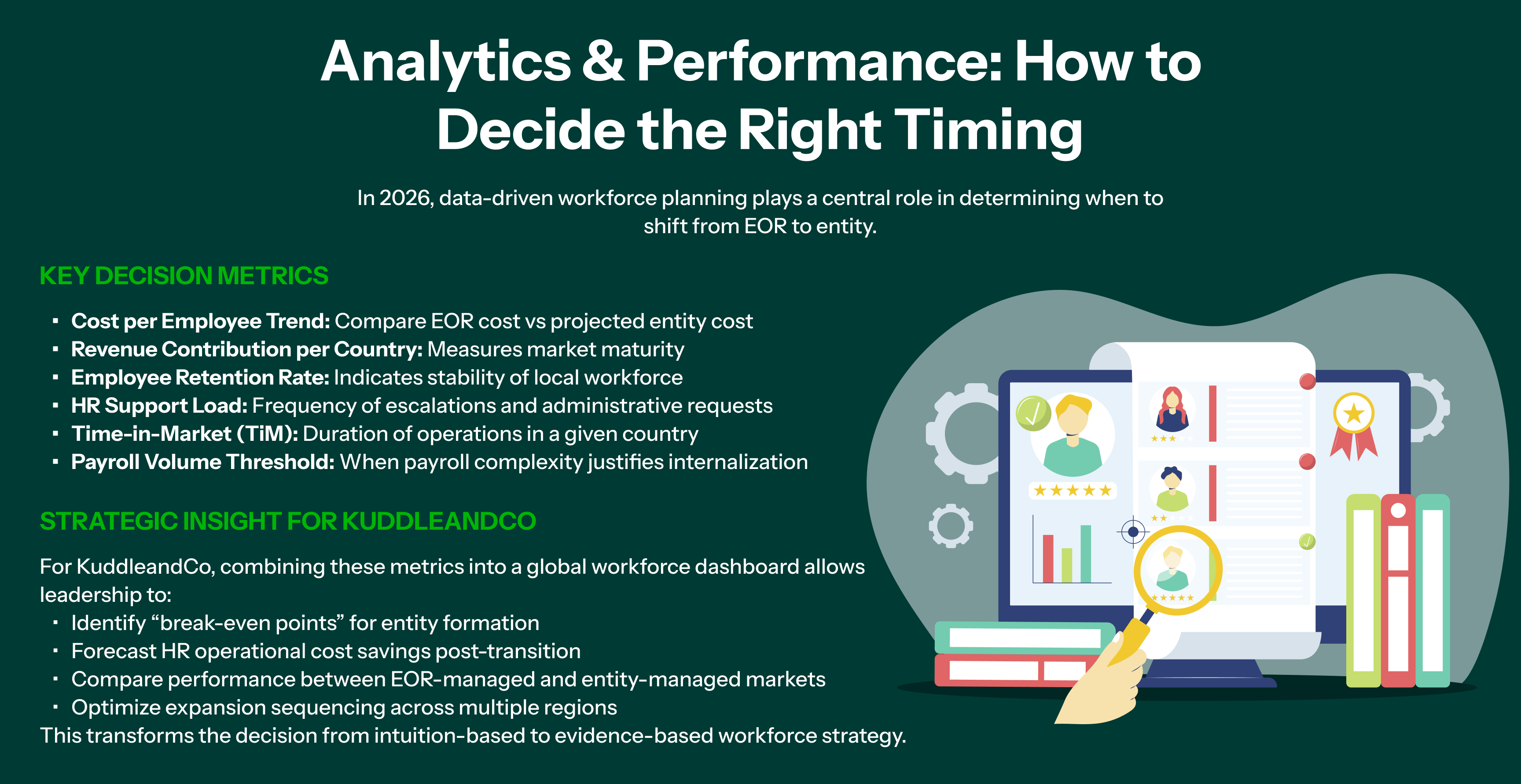
For KuddleandCo, the key is timing: move too early, and you lose EOR flexibility; move too late, and you overpay for scalability. The optimal approach is a data-driven transition aligned with market maturity, headcount scale, and revenue stability.
Organizations that treat this decision as a strategic lever—not a compliance requirement—will scale more sustainably and competitively in global markets.
References
- OECD. Employment
- International Labour Organization. Employment promotion
- World Bank Group. Competitiveness