
In 2026, workforce management is no longer an operational function buried inside HR—it is a board-level strategic capability. Artificial intelligence is now embedded across hiring, performance management, compliance, and global workforce planning, reshaping how executives make decisions about talent at scale.
For leaders navigating this shift, the challenge is no longer whether to adopt AI-powered workforce systems, but how to integrate them responsibly, efficiently, and globally.
Organizations working with providers like KuddleandCo are increasingly combining AI-driven workforce intelligence with structured employment models such as PEO (Professional Employer Organization) and EOR (Employer of Record) to build scalable, compliant, and data-driven workforce ecosystems.
Key Benefits of AI-Powered Workforce Management for Executives

Enterprise-Wide Workforce Visibility
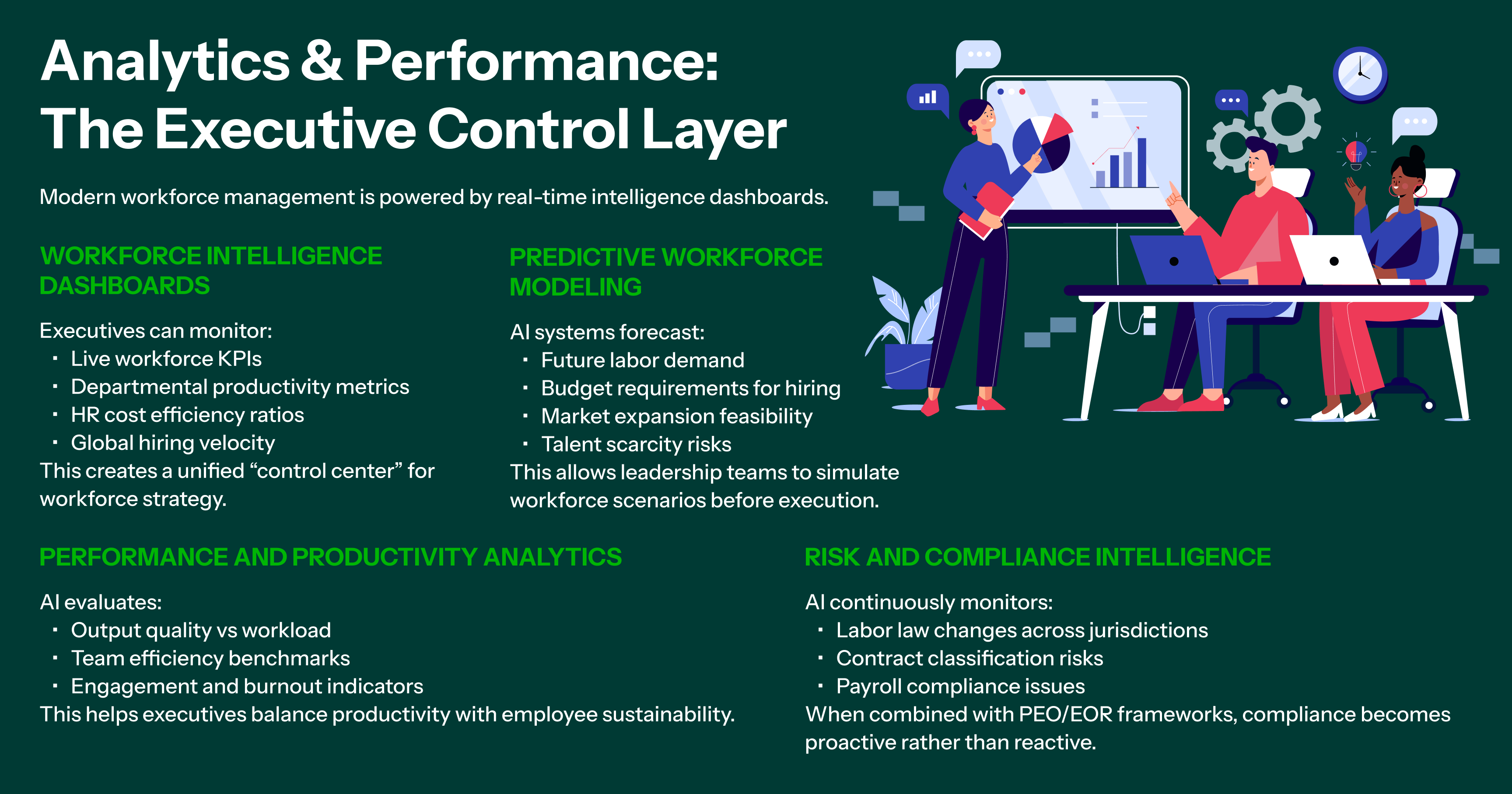
Executives gain real-time visibility into:
- Headcount distribution across regions
- Productivity trends by department
- Workforce utilization rates
- Cost-per-employee metrics
This enables faster, evidence-based decision-making at scale.

Strategic Workforce Planning
AI enables predictive planning for:
- Future hiring needs
- Skill shortages and surpluses
- Expansion readiness
- Attrition risks
Instead of reacting to gaps, organizations can anticipate them.

Cost Optimization Across Global Teams
AI identifies inefficiencies in:
- Workforce allocation
- Regional salary structures
- Overlapping roles and redundancies
This supports leaner and more cost-effective operations without reducing output quality.

Faster and Smarter Talent Decisions
Executives can evaluate:
- Time-to-hire performance
- Talent pipeline strength
- Recruitment channel efficiency
This shortens decision cycles and improves hiring precision.

Scalable Global Workforce Expansion
With structured support from KuddleandCo, companies can expand globally without:
- Establishing local legal entities
- Building country-specific HR teams
- Managing fragmented compliance systems

Where AI Alone Is Not Enough
Even in highly automated environments, AI has clear limitations in executive workforce management.
1. Strategic Judgment Cannot Be Automated
AI provides insights, but executives must interpret them within business context and long-term strategy.
2. Legal Accountability Remains Human-Led
Compliance violations still carry organizational liability, requiring structured oversight.
3. Cross-Border Employment Complexity
Global hiring involves legal, tax, and cultural considerations that require expert operational frameworks.
The Critical Role of PEO and EOR in Executive Workforce Strategy
PEO and EOR services remain foundational in global workforce management.
PEO (Professional Employer Organization)
Supports:
- HR administration
- Payroll and benefits management
- Shared compliance responsibility
EOR (Employer of Record)
Enables:
- Legal hiring in foreign countries
- Cross-border employment compliance
- Local payroll execution
The Executive Advantage: AI + Structured Workforce Systems
Conclusion
AI-powered workforce management is redefining executive leadership in 2026. It enables organizations to move from reactive HR operations to predictive, data-driven workforce strategy at a global scale.
However, AI alone is not enough. The most resilient workforce strategies combine:
- AI-powered intelligence
- Structured PEO and EOR frameworks
- Human strategic oversight
This integrated approach ensures that organizations can scale efficiently, remain compliant, and make smarter workforce decisions in real time.
With support from providers like KuddleandCo, executives can transform workforce management into a strategic growth engine built for global competitiveness and long-term resilience.