
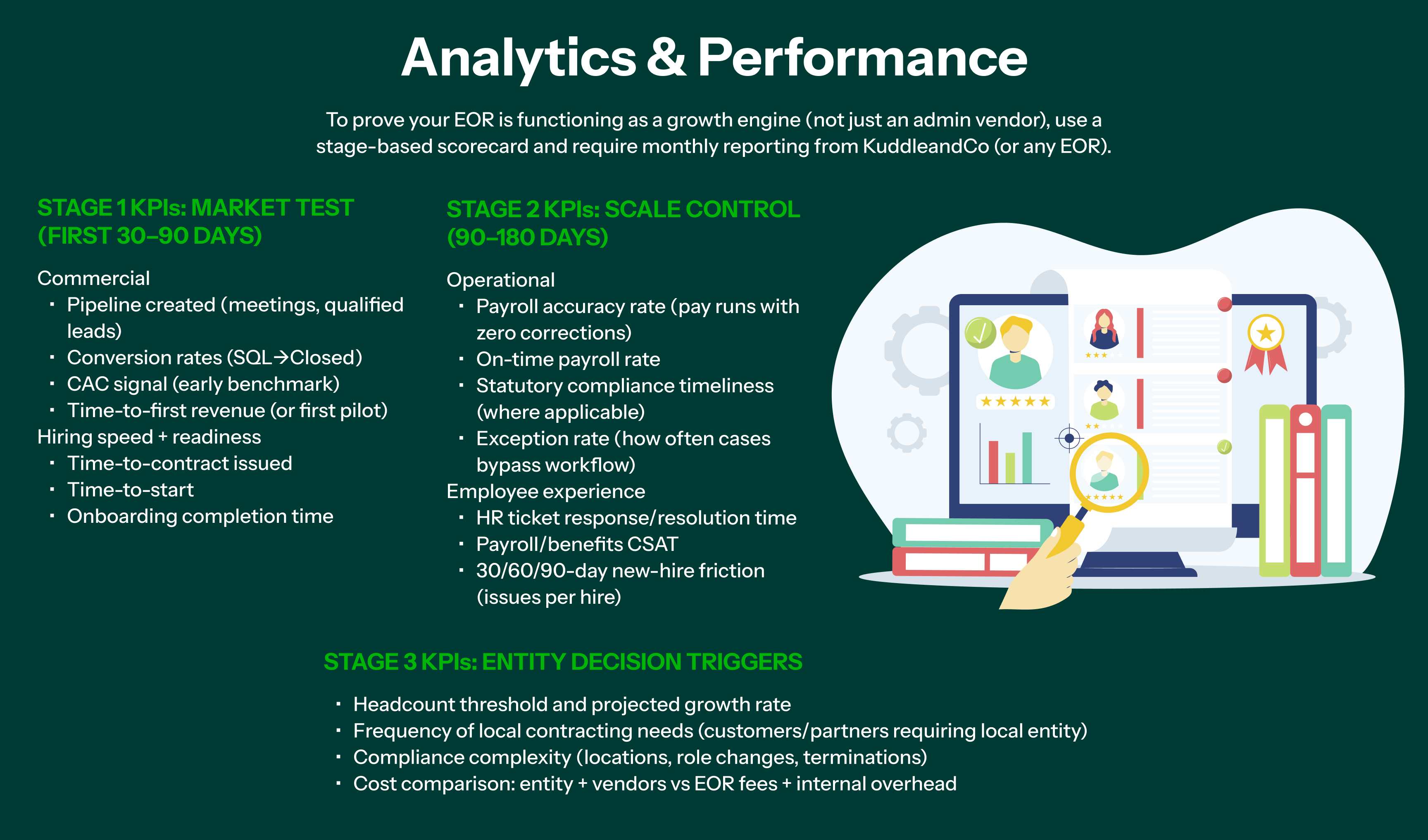
In 2026, an Employer of Record (EOR) is no longer just a “global hiring workaround.” For many fast-growth companies, it’s a growth engine—a way to enter new markets quickly, validate demand with minimal fixed cost, and then scale (or exit) cleanly based on real performance.
Analyst definitions capture the core advantage: an EOR lets companies hire, onboard, and manage employees in multiple countries without establishing a local entity, while the client still directs day-to-day work.
If you’re positioning a provider, this is where KuddleandCo fits naturally: enabling speed with governance so market testing doesn’t turn into compliance debt.
Key Benefits

Stage 1: Market testing without entity setup friction
“Market testing” is the most underused EOR use case. Instead of spending months on entity formation, local banking, and vendor setup, you can hire a small in-country team (e.g., 1–5 people) to test:
- pipeline and conversion (sales)
- implementation feasibility (ops/CS)
- partner/channel traction
- local talent availability and compensation realities
This works because the EOR model explicitly supports hiring without creating a local entity.
Practical play: launch with a “minimum viable team” (GM + sales/CS), set 90-day KPIs, and decide whether to scale or exit based on evidence.

Stage 2: Controlled scale while you build repeatable operations
Once the signal is positive, the next bottleneck is usually operational consistency: contracts, payroll, statutory benefits, compliant onboarding, and change management as headcount grows.
A strong EOR becomes the local compliance and payroll operating layer—handling payroll-related tasks and compliance while you supervise work and performance.
How top teams use EOR during scaling:
- Standardize onboarding checklists and documentation
- Lock payroll calendars and approvals to prevent “off-cycle chaos”
- Put role/location change approvals in place (especially for remote-first teams)

Stage 3: “Entity or EOR?” decision based on maturity, not hype
EOR doesn’t have to be permanent. In 2026, many companies use EOR as a bridge:
- Stay on EOR if headcount is modest, locations are still fluid, or your org is still learning the market.
- Move to an entity when you need local contracting, deeper operational control, or larger headcount economics.
A clean EOR partner supports this by keeping documentation and employment operations structured—so you can transition without unraveling your workforce.

Why speed matters more in 2026: talent scarcity + first-mover execution
Speed isn’t just about “expanding fast.” It’s also about hiring before competitors do, especially for in-demand skills.
ManpowerGroup’s 2026 Talent Shortage Survey reports 72% of employers have difficulty filling roles, with AI skills rising to the top.
That reality makes EOR-driven hiring velocity a strategic lever, not an HR detail.

Risk control: remote work and “where people work” can create exposure
Market testing often includes remote-first execution. But cross-border remote work can raise tax and compliance questions, including permanent establishment (PE) risk depending on facts.
The OECD’s 2025 update explicitly addresses when cross-border remote work (e.g., home office) can create taxable presence.
Good EOR programs treat location as a controlled variable, not a casual preference.

Conclusion
In 2026, EOR is best understood as a growth engine with stages:
- Test the market quickly without entity drag
- Scale with control—payroll, benefits, contracts, and compliance handled operationally
- Transition deliberately to an entity only when the business case is proven
Layer in the reality of 2026—persistent talent scarcity and growing cross-border risk from remote work —and the EOR model becomes less about HR outsourcing and more about speed-to-market with governance.
Position KuddleandCo as the partner that supports the full arc: market testing → controlled scale → clean expansion—with reporting that proves it.
References
- Gartner Peer Insights — Employer of Record (EOR) market definition
- Velocity Global — What Is an Employer of Record (EOR)?
- ManpowerGroup — 2026 Talent Shortage Survey press release (72% difficulty filling roles